How Bosnia’s transformation could help close NATO’s ammunition gap, bolster Western deterrence, and reposition the country as a proud contributor to global security.
The United States and its allies are facing a severe shortage of munitions, threatening Western readiness at a time of escalating global conflict. In July 2025, the U.S. paused shipments of Patriot missiles and 155 mm artillery shells to Ukraine to preserve dwindling stockpiles at home, for example.
The delayed shipment included dozens of Patriot interceptors, nearly 8,500 155mm shells, over 250 precision GMLRS missiles, and 142 Hellfire missiles, highlighting acute vulnerabilities in U.S. inventories depleted by ongoing aid to Ukraine and Middle East operations. Pentagon officials have repeatedly acknowledged the need to “rebuild capacity for sustained deterrence” after decades of underinvestment in ammunition manufacturing, with the FY2025 budget request cutting key conventional precision munitions funding by $1.2 billion from prior levels, prioritizing other areas amid fiscal constraints.
The problem extends beyond America. NATO leaders warned that member nations’ stockpiles remain far below requirements for long-term defense commitments, prompting an urgent call to agree on new weapons and troop goals ahead of the summer summit in The Hague. This follows earlier assessments revealing shortfalls in critical items like 155mm shells, HIMARS missiles, and air defense ammunition, exacerbated by deliveries to Ukraine.
NATO’s push for higher stockpile targets and a 3.5 percent GDP defense spending commitment by 2035 underscores the alliance’s scramble to restore readiness.
This shortage is expected to worsen as Russia and China ramp up their military production. Russia began constructing a major explosives plant at the Biysk Oleum facility in Siberia in 2023, with expansions continuing through 2024 to produce up to 6,000 tons of RDX and HMX explosives annually — enough for over 1.28 million 152mm artillery shells — aimed at sustaining its Ukraine operations amid sanctions and imports from North Korea.
Meanwhile, China has accelerated its defense industrial expansion, surpassing 600 operational nuclear warheads by mid-2024 and advancing conventional capabilities tailored for potential Pacific conflicts, including rapid nuclear buildup and integrated defense production to challenge U.S. dominance in the Indo-Pacific.
Western defense analysts warn the U.S. risks dependency on foreign suppliers without expanding its industrial base. The Pentagon’s export pauses reflect broader concerns that production capacity, not just policy, will determine future security, as evidenced by calls for supplemental funding to replenish stocks depleted by Ukraine aid and regional operations.
Amid this global scramble, sources told the Washington Reporter how Bosnia and Herzegovina is emerging as an unexpected solution. With a rich industrial history and strategic Balkan location, Congressional and Defense sources tell the Reporter that Bosnia has the foundation to become a key supplier of NATO-standard ammunition. Bosnia formally opened EU accession negotiations in March 2024, following the European Commission’s recommendation, aligning its standards with European procurement and export controls essential for NATO contracting.
At the heart of that potential is Pretis, a munitions manufacturer in Vogošća that once produced up to one million artillery rounds annually.
At the recent Sarajevo Security Conference, a major regional defense forum convening NATO officials, policymakers, and industry leaders, Will Somerindyke, the Chairman of U.S.-based Regulus Global, which holds a stake in Pretis, unveiled a plan to position Bosnia as a world-class munitions hub. This is crucial because it offers the U.S. and our allies an opportunity to address the munitions crisis.
The Reporter received a copy of Somerindyke’s speech, and he told the Conference: “Across Europe, lines are restarting, plants are modernizing, and long-term orders are being placed. It’s more than a race; it’s an invitation for trustworthy makers who can deliver at scale. Bosnia has the heritage, the workforce, and the strategic position to answer that call.”
Somerindyke pledged a $100 million modernization plan for Pretis, focusing on upgrading production lines, digitizing operations, and achieving EU/NATO quality and compliance standards.
Somerindyke outlined a seven-point roadmap for Bosnia’s industrial transformation (taken from draft provided to the Reporter):
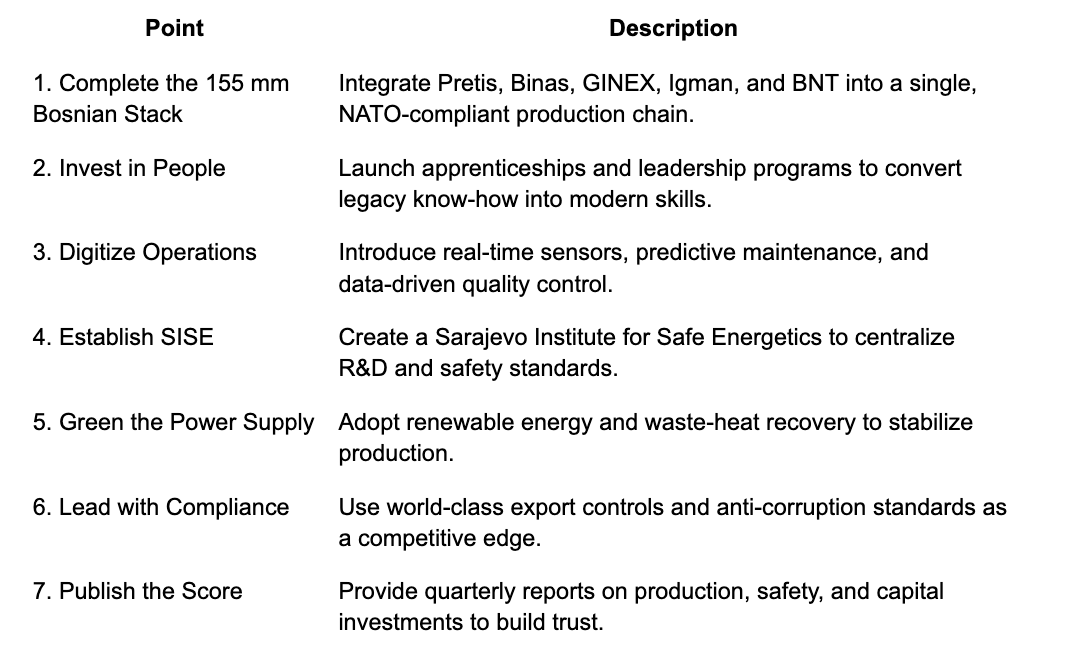
“When transparency, predictability, and professionalism replace politics, investment flows, lines run, and communities prosper,” Somerindyke told delegates.
One congressional source told the Reporter that “addressing the munitions crisis is one of the last things that both parties agree is an absolute necessity. Both Senate and House Armed Services Members are pushing for solutions to build more munitions in America, but it’s clear that working with allies like Bosnia also has to be part of the solution.
Somerindyke closed with a vision of renewal: “History gave us a workshop. The future demands a world-class factory. The only thing between the two is our decision to build — starting tonight.”
If realized, Bosnia’s transformation could help close NATO’s ammunition gap, bolster Western deterrence, and reposition the country as a proud contributor to global security.