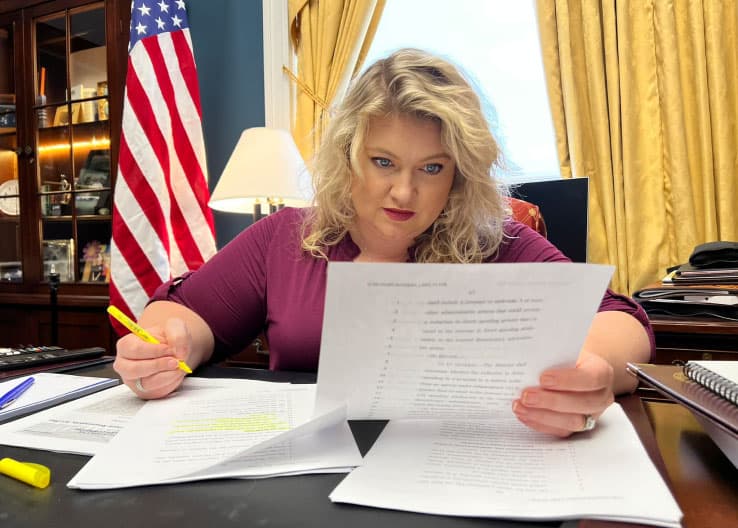
Rep. Kat Cammack (R., Fla.) is ending 2025 leading one of Congress’s final legislative fights — over if and to what extent Congress should regulate app stores.
Cammack, a new mother, spoke with the Washington Reporter about her App Store Freedom Act, which she bills as legislation needed to tackle a “monopoly” between Apple and Google, whose App Store and Google Play store control app access for most Americans.
“Basically everybody is living on their phones today, and if I want to download an app store, I buy the phone, and I can’t delete certain apps,” she said. “One of the most frustrating things is when you get a brand new iPhone, which I just did, and you go to try to delete certain apps because you prefer this company over another. You can’t! If I want to download a Kindle book, I have to go to the browser because I can’t make the purchase through the app. You start asking questions like why is this? That sets you down this path of fact finding. And then you start uncovering layer after layer after layer.”
“First thing you realize,” she added, “is I really can’t put the apps that I want on my phone because they’re direct competitors to an Apple product; that’s annoying, but it’s not the end of the world. You can’t manage your subscriptions in certain apps because this company isn’t willing to pay the 30 percent tax to Apple, and so you gotta go on a desktop. Then you start digging into the reasons why all this exists. And then you hear the first thing, which is that it’s a security thing. They can spare me on any security argument, because when you, as a company, are hosting Chinese military-developed VPNs, 60 plus of them, on your platform, in your app store, and you continue to let them exist, you can’t sit there and say that you’re doing this for security purposes.”
During her work on the bill, Cammack started “hearing from other companies that say ‘we’ve tried to update our app and we can’t. They slow walk our updates, or they steal our technology.’”
“The cornerstone of the American experiment is competition and free markets,” she said. “When you control 99 percent of the marketplace, that is not free market, that is monopoly. And so at present, you have Google and Apple acting as a monopoly, and they are doing everything they can to prevent that from breaking up. They want pure control of data, which is truly the currency of tomorrow, but they want to make sure that they control everything.”
Cammack is pitching her bill as an antitrust measure that bolsters competition and also addresses the “kid safety” problems she sees in the status quo.
“In one of our hearings, I highlighted that we have exposed repeatedly, ‘nudify’ apps that Apple rated as safe for 2-year-olds,” she explained. “In Florida alone, there were 13- and 14-year-old boys who were taking pictures of 12-year-old classmates in their school and nudifying them and sharing the photos. And Apple still kept those apps on their platform in their store and rated them safe for 4-year-olds. It couldn’t possibly be because they make money, right? I come to find out it’s a $406 billion a year business for Apple; they have billions of reasons as to why they want to maintain control of this monopoly.”
At 37, Cammack is one of the youngest members of Congress, which she said is part of why she is one of the leading voices on this bill. “A large share of Congress is made up of some seasoned members who don’t even really understand what the App Store is, or the app marketplace as a whole,” she said. “Just candidly, I’ll tell you, I have had multiple members come to me and ask for help downloading apps, because they don’t understand how to do it.”
Cammack’s bill is certainly controversial — and she addressed her critics, who have levied criticisms that her push is “socialist,” and that “Lina Khan wrote this bill.”
“No,” she said. “This is the antithesis of any sort of overboarding socialist policy…This is a quintessential free market bill, really allowing the marketplace to innovate. The small developers are actually going to have a fighting chance to push out new products and innovations, versus being tamped down. That is something that I believe is a cornerstone of free market principles and conservative politics.”
Several smaller developers are some of the biggest proponents of her move. Among them, she said, are “Spotify, X, any of the dating apps, Epic Games is a great one that has led the charge in the courts against these antitrust issues.” Those companies, she said, frequently argue that app stores’ rules are “just a gatekeeping mechanism, and not only are they getting charged with a 30 percent fee, but then all of the data for their customers and their users is being held by Apple.”
While Apple and Google are leading the charge against Cammack’s bill, she told the Reporter that she thinks they will ultimately come around to her view.
“It’s good for consumers, it’s good for the innovators, it’s good for everyone,” she said. “And I think in the end, it will actually be good for Apple and Google, because it’s going to force them to close loopholes that have existed in their systems, that have caused data breaches, that have real concerns and dangers for kids. It’s going to have all sorts of benefits for them, maybe not the dollars and cents right out the gate, but it’s going to force them to innovate and grow in ways that they aren’t currently interested in doing.”
Below is a transcript of our interview with Rep. Kat Cammack, lightly edited for clarity.
Washington Reporter:
Congresswoman, you’ve been making waves with your App Store Freedom Act lately; that’s led to some testy hearings. What’s been building up to this, and what led to your frustrations about Big Tech?
Rep. Kat Cammack:
Basically everybody is living on their phones today, and if I want to download an app store, I buy the phone, and I can’t delete certain apps. One of the most frustrating things is when you get a brand new iPhone, which I just did, and you go to try to delete certain apps because you prefer this company over another. You can’t! If I want to download a Kindle book, I have to go to the browser because I can’t make the purchase through the app. You start asking questions like why is this? That sets you down this path of fact finding. And then you start uncovering layer after layer after layer. First thing you realize is I really can’t put the apps that I want on my phone because they’re direct competitors to an Apple product; that’s annoying, but it’s not the end of the world. You can’t manage your subscriptions in certain apps because this company isn’t willing to pay the 30 percent tax to Apple, and so you gotta go on a desktop. Then you start digging into the reasons why all this exists. And then you hear the first thing, which is that it’s a security thing. They can spare me on any security argument, because when you, as a company, are hosting Chinese military-developed VPNs, 60 plus of them, on your platform, in your app store, and you continue to let them exist, you can’t sit there and say that you’re doing this for security purposes. We all remember Parler, and as conservatives, it was really troubling for us to see Parler being deplatformed, and there were a lot of free speech concerns. Apple, without any warning, deplatformed them. Then you start hearing from other companies that say ‘we’ve tried to update our app and we can’t. They slow walk our updates, or they steal our technology.’ Curiously, they pop up with a competitor directly of that company. It’s bizarre. And so you start saying how does this all come together? And why is this important? The cornerstone of the American experiment is competition and free markets. When you control 99 percent of the marketplace, that is not free market, that is monopoly. And so at present, you have Google and Apple acting as a monopoly, and they are doing everything they can to prevent that from breaking up. They want pure control of data, which is truly the currency of tomorrow, but they want to make sure that they control everything. And they’re here saying ‘we’re safe, trust us.’ If they’re saying, trust us, you shouldn’t, and that’s where we’re coming from. So there’s competition element to this. There is a kid safety element to this. In one of our hearings, I highlighted that we have exposed repeatedly, “nudify” apps that Apple rated as safe for 4-year-olds. In Florida alone, there were 13- and 14-year-old boys who were taking pictures of 12-year-old classmates in their school and nudifying them and sharing the photos. And Apple still kept those apps on their platform in their store and rated them safe for 4-year-olds. It couldn’t possibly be because they make money, right? I come to find out it’s a $406 billion a year business for Apple; they have billions of reasons as to why they want to maintain control of this monopoly.
Washington Reporter:
How does the fact that you are one of the youngest members of Congress play into this discussion?
Rep. Kat Cammack:
I think the reason why we are one of the champions of this and are leading on this is because a large share of Congress is made up of some seasoned members who don’t even really understand what the App Store is, or the app marketplace as a whole. Just candidly, I’ll tell you, I have had multiple members come to me and ask for help downloading apps, because they don’t understand how to do it. They don’t understand how it works. And it’s just part of the evolution here in Congress. It’s not exactly tech-centered or tech forward, and there’s a lot of catching up to do, and so it makes sense that someone who grew up with a little bit of analog and a whole lot of digital would understand why the current state of play is so dangerous.
Washington Reporter:
You’re rolling out legislation on this issue. How would your bill address the concerns that you were talking about?
Rep. Kat Cammack:
It fosters competition. It’s about competition, empowering parents, protecting kids. Because right now, if I wanted to sideload a marketplace I couldn’t, because Apple prohibits that. You can’t delete it off of your phone, but as a new mom, I would love nothing more than to be able to download a marketplace on my phone that is filled with apps that are actually vetted and created by parents and experts in industry that I know are safe. You can’t do that currently. We’re just simply having to “trust” that Apple and Google have vetted these apps, when in fact, we know after countless investigations that they’re not. It’s a money thing.
Washington Reporter:
You’ve already addressed how the current status quo can hamper child safety. But how do you ensure that regulation will not hamper competition?
Rep. Kat Cammack:
The ability to sideload fosters the competition. Right now, there is no competition. You have to “mother may I” to Apple, where you submit all of your app to review or update. They have full access to source code. They’re able to basically rip any element, and we’ve seen them do that repeatedly. For the small app developer, this bill is about getting a fair shot. It’s about breaking down the walled gardens that the App Store is, and that the Google Play store is. The cornerstone of the American experiment is competition and free markets, and making it so that the little guy has a fighting chance; right now, you don’t have a fighting chance. No marketplace can be established in the United States because they control 99.99 percent.
Washington Reporter:
Can you talk more broadly about how you view antitrust in general? You’re invoking walled gardens; how do you think about this as one of the bigger questions of the economy?
Rep. Kat Cammack:
Think about from the perspective of a conservative; remember how a couple of years ago, everyone was talking about Section 230 reform, and that there was a whole lot of censorship going on. And we needed to talk about how there were these big players like Meta. And back then, it was Twitter, before they became X. They were really dominating the space, the new public square. The App Store is effectively the mall of America. And what they’re doing is they are buying up all the land around it and then rezoning it so that you can only use it for agriculture, but you can’t use it for commercial purposes. That right there is a violation of all the antitrust laws that we have on the books, but because there are certain protections afforded in this space, because Congress always is retroactive, rather than proactive in this space, that allowed them to build up into effectively a monopoly. We have to be facilitators of commerce. I don’t want additional regulation. I want industry to drive an open, free market space, but in this case, you have bad actors that are basically violating the very tenants of what they’re claiming to protect.
Washington Reporter:
How would your bill enhance child safety with increased competition in the marketplace?
Rep. Kat Cammack:
In one of our hearings, the experts actually hit on this, and I truly encourage you to check it out. The biggest thing is it protects children’s data, because currently, there are legislative solutions that put Apple in the driver’s seat for protecting kids’ data. Why would we trust an entity that is recommending nudify and sex chat apps for four years saying, “trust me, I’m going to protect kids, but, I’m also going to market to them all these unsafe adult products.” That doesn’t make any sense. I believe that parents need to be empowered and have the ability to create free market solutions, in this case, sideloading and creating new marketplaces that can then be downloaded on phones if they so choose. The same parental controls and channels and everything will be in place, but this would allow them to say “we’re going to create a marketplace that is for 12-year-olds.” You can’t do that currently. It’s prohibited. That is what this bill would accomplish: it puts parents in the driver’s seat to say, “maybe we don’t really trust Apple with our kids’ data, with our data. We don’t trust that their vetting policies are actually being effective. We’re going to go and create our own marketplace, our own mall of America, where all the products and everything in there we know is 100 percent safe.”
Washington Reporter:
Walk us through the practical way this would be implemented. You have a phone, and it would be an app store separate from, let’s use iPhone, separate from the App Store where you would download apps. Then what?
Rep. Kat Cammack:
You would have another marketplace, and then you would have another marketplace that you could download on your phone. This is a quintessential free market bill, really allowing the marketplace to innovate. The small developers are actually going to have a fighting chance to push out new products and innovations, versus being tamped down. That is something that I believe is a cornerstone of free market principles and conservative politics. I’ve had people say “Lina Khan wrote this bill.” No; this is the antithesis of any sort of overboarding socialist policy. And it’s because Apple has an incredibly large lobbying wing. They’re closing in on over $10 million and an army of lobbyists to shut down this bill, and it’s because the 30 percent tax that they charge to every single app, and then they want you to use their merchant services, they get a cut, they get a 30 percent cut of all the transactions happening in the store. So of course, it’s big business. This is a $406 billion a year industry for them with just the App Store alone, on top of the sales for phones and computers and everything else. They have billions of reasons as to why they would not want this to come through. So they’re going to call it everything in the book. They’re going to level every charge they can. But at the end of the day, it’s about free markets, about empowering parents, protecting kids, and supporting free markets. This is how we do it.
Washington Reporter:
With the fees and the taxes that Apple charges for developers, how do you view what developers get for the fee that they are charged? Is it a fair trade for them?
Rep. Kat Cammack:
If you talk to any app, particularly those that have been very vocal about this, like Spotify, X, for example, has come out in support of our bill, any of the dating apps, Epic Games is a great one that has led the charge in the courts against these antitrust issues, they would say that it is just a gatekeeping mechanism, and not only are they getting charged with a 30 percent fee, but then all of the data for their customers and their users is being held by Apple.
Washington Reporter:
Where does the value come from to the iPhone user? Is it the individual apps, or is it the marketplace that you have?
Rep. Kat Cammack:
This bill is all about consumer choice and empowering consumers, empowering parents. And parents are consumers. So this bill would give people choice, it would give them options. It would say you don’t have to use the App Store if you don’t want to. Proton, for example, everyone in any sort of encrypted messaging or privacy space privacy. They typically use VPNs or they use Proton Mail, for example. Proton is a huge supporter of this bill because they are nervous that Apple is going to compromise the data because they’ll have to download Proton VPNs and Proton Mail apps through that marketplace. By virtue of being able to have a marketplace that you could put on your phone that does not have you going through the App Store or the Google Play store, you would be able to have a safer product with more choice, and those companies don’t have to host on all the third party market marketplaces, but it gives them options. It’s like saying you want to be able to write your stories for multiple outlets, that’s the option. So it’s good for consumers, it’s good for the innovators, it’s good for everyone. And I think in the end, it will actually be good for Apple and Google, because it’s going to force them to close loopholes that have existed in their systems, that have caused data breaches, that have real concerns and dangers for kids. It’s going to have all sorts of benefits for them, maybe not the dollars and cents right out the gate, but it’s going to force them to innovate and grow in ways that they aren’t currently interested in doing.
Washington Reporter:
Congresswoman Cammack, thanks for chatting.