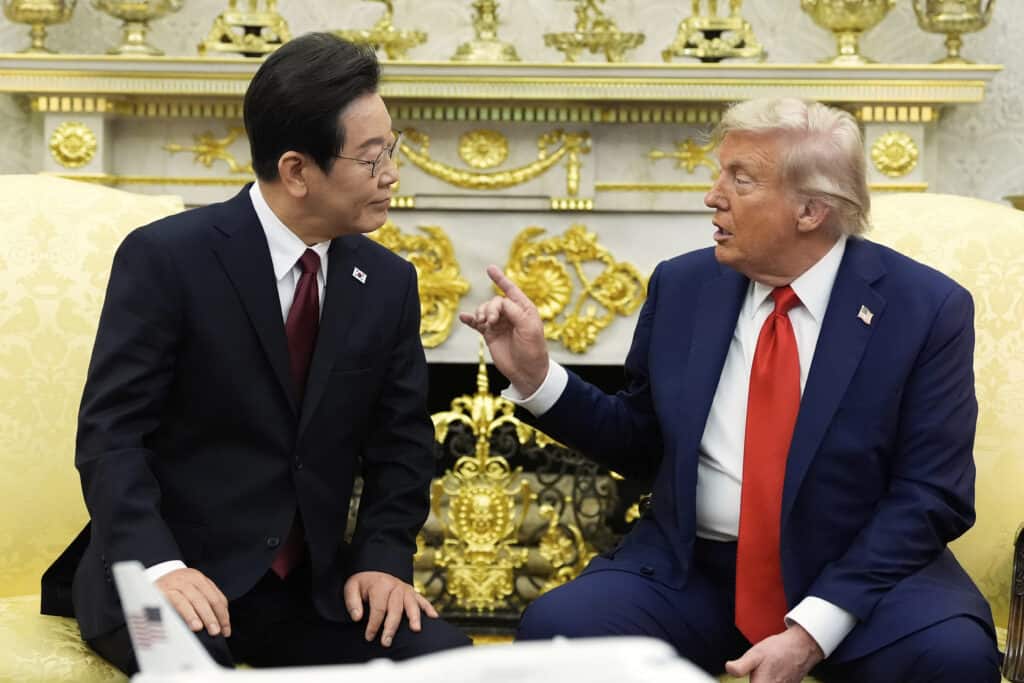
For eight decades, the United States and the Republic of Korea have built an alliance of mutual respect, a partnership of shared values, and a freedom-loving friendship that has bound our nations together culturally, diplomatically and economically. Our strategic relationship is vitally important, but Seoul’s selective regulation of U.S. technology firms needs a correction.
In the most recent trade agreement, Seoul clearly and unambiguously committed to ensuring that American companies would not face discriminatory treatment in digital services and related sectors, particularly the type of policies we have seen emerge in the European Union. The agreement states plainly that “[t]he United States and the ROK commit to ensure that U.S. companies are not discriminated against and do not face unnecessary barriers in terms of laws and policies concerning digital services.”
Despite this commitment, we are seeing a growing pattern of regulatory and enforcement actions that appear to single out American technology companies. Concerning tactics include raids on company offices, threats to revoke business licenses, travel restrictions on U.S. citizens, punitive fines, and a series of disruptive and questionable government investigations. These actions are difficult to reconcile with the joint declaration of principles.
The economic stakes are significant. Recent analysis shows that regulatory actions, particularly those targeting digital services and e-commerce, will cost the U.S. economy $525 billion over the next decade — nearly $4,000 per American household. These numbers reflect lost investment, reduced exports and fewer opportunities for American businesses competing in global markets.
That’s why we joined 52 of our Congressional colleagues in relaying these concerns directly to the Korean Ambassador to the U.S., Kyung-wha Kang. Our letter outlines specific areas of concern and calls for a course correction that aligns with our shared commitments. China’s long and escalating economic warfare against capitalism cannot be fought alone. The United States has been clear: We need strong allies to counter China’s scheme of death-by-a-thousand subsidies.
Under the agreed-to principles, U.S. companies should not be singled out for harassment and unfair, punitive treatment.
This is not only in the interest of U.S. tech firms, but in the interests of Korean consumers. If U.S. companies are forced out of critical sectors like e-commerce and digital services, the void will be filled by Chinese companies, including Temu, Alibaba and Shein, which answer not to free markets, but the state-sponsored mandates of the Chinese Communist Party.
The contrast with the United States is clear. Korean companies are welcomed here and have thrived under transparent, rules-based systems. Recent agreements alone underscore the scale of that openness. Korean Air’s $36 billion purchase of Boeing aircraft and $13.7 billion in GE Aerospace engines will support more than 135,000 American jobs. Korean firms are investing billions more in U.S. energy, shipbuilding, and power-grid infrastructure. Partnerships across AI, cloud computing, and critical minerals are deepening our shared technological leadership.
These are not isolated transactions—they reflect a consistent U.S. commitment to open markets and reciprocal growth. But it cannot be a one-way street. This is not about seeking special treatment for American firms in Korea — it is about ensuring that the same basic standards of fairness and reciprocity apply in both directions.
Ultimately, South Korea is not just another trading partner. It is a treaty ally with whom we coordinate some of our nation’s most sensitive security challenges and where 30,000 U.S. troops are stationed right now on the Korean Peninsula helping to keep the peace. This kind of alliance — if it is built to last — must be built on trust.
We remain ready to work with our South Korean partners to address these concerns, because the long-term strength of our alliance and the credibility of our economic partnership depend on getting this right. Our strategic relationship is too important.
Rep. Darrell Issa represents California’s 48th District. Rep. Michael Baumgartner represents Washington’s 5th District. They are both members of the House Judiciary and Foreign Affairs committees.