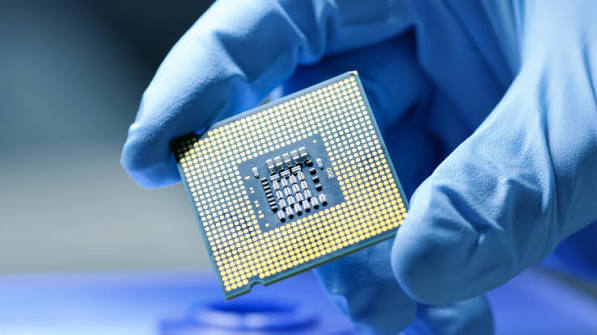
The Trump administration has a laser-like focus on putting America first by protecting domestic manufacturing. That is especially important in industries that also happen to be essential to national security, such as the high-tech semiconductor industry.
The United States literally invented semiconductors, and in the earliest days of the technology most were made here and used here. Americans invented new and better products and Americans manufactured those products in American factories.
America was the leader partly because U.S. government policy encouraged semiconductor manufacturing. “Early industrial policy provided roles for a variety of participants: small firms experimented at the technological frontier, while large firms pursued process improvements to ensure those innovations scaled up,” Employ America wrote.
Over time, foreign governments ate away at that advantage. They gave local manufacturers subsidies and supports to encourage high tech manufacturing in their countries. They dumped products, selling them below cost into the American market. That created dependence on other countries, often in Asia.
Now, the problems are out in the open.
“Fissures in the supply chain exposed by the pandemic show that — given their status as a general purpose technology with a role to play in almost every major supply chain — semiconductor production is a crucial economic and national security concern,” Employ America noted. This is why the administration’s policies to encourage the reshoring of semiconductor production make sense. The administration is using tariffs to protect the industry.
But there is a fine line between protecting an industry and damaging one.
Under the Biden administration, the government placed tariffs on Chinese semiconductors. President Donald Trump threatened to go further and double the price of imported semiconductors by imposing a tariff of “approximately 100%” on semiconductors and chips. He is still considering steep tariffs. This would do more harm than good, because it is simply too much too soon. It would be impossible to stand up domestic manufacturing quickly enough to provide the semiconductors the country needs, and prices would soar.
That’s a problem, because our national security infrastructure is reliant on imported semiconductors.
Modern defense systems rely on semiconductors at every level, from missile defense systems and secure communications equipment to satellites, radar, cybersecurity infrastructure, and other AI-enabled capabilities.
Supply chain disruptions that delay or increase the cost of these components could ultimately slow down procurement, weaken readiness, and increase costs across the defense industrial base. That is especially concerning at this moment, with the U.S. expending high tech weapons in the Middle East and trying to ramp up production of interceptor missiles to protect our troops and allies.
Simply put, the U.S. cannot maintain its technological and military advantage if critical inputs become unnecessarily more expensive or difficult to obtain. Research from the Information Technology & Innovation Foundation (ITIF) suggests that a 25 percent semiconductor tariff would reduce information communication and technology consumption by 26 percent. That would harm U.S. businesses, workers, and capital investment throughout the economy.
Further, ITIF estimates that a 25 percent semiconductor tariff would reduce U.S. GDP by a cumulative $1.6 trillion —3.9 percent — if the tariffs last a decade. Under the same analysis, a 50 percent tariff would reduce GDP by $4.4 trillion —10.3 percent — in the same time frame.
The U.S. can’t afford to crush the semiconductor industry that we still rely on in this way. “Technological innovation occurs across every part of the supply chain, and benefits from a diverse array of players and a dynamic labor market,”Employ America writes. “Policymakers should be cognizant of the lessons from semiconductor industrial policy when addressing the present shortage, and work to create the kind of robust competitive ecosystem needed to spur innovation.” That means smart, limited tariffs that encourage manufacturing in America.
The Trump administration should consider a more targeted tariff policy, one that protects the semiconductor industry and encourages American manufacturing, while also protecting national security and downstream consumers. That’s one big, key flex toward making America great again.
Christian Josi is a veteran political and media strategist, nonprofit executive, and an author and columnist for a variety of publications.