On Wednesday, the third anniversary of the October 7 massacre, I will be standing outside the front gates of McGill University, the school Americans like to call “the Harvard of Canada,” with a camera in my hand, since nobody will tell us what will actually happen there. Students for Palestine’s Honour and Resistance (SPHR), a network of campus chapters across Montreal, has called a protest there.
Its poster’s Arabic slogan reads: “From the water to the water, Palestine is Arab” with the famous photo of Gazan terrorists in civilian clothes using a bulldozer to break the border wall with Israel and crossing into Israel to commit the most abhorrent atrocities.
The next evening, the union representing Concordia University’s student teaching and research assistants (CREW-CSN) will host a “collective reading” of The Thorn and the Carnation by Yahya Sinwar, the Hamas leader who masterminded Oct. 7. The flyer shows Sinwar relaxing in an armchair amid the rubble with pink flowers around him. Dinner is even included!
And this is only what they promote publicly. Would you tell your kids it is safe to go to university the day after these events take place?
This is Montreal, Canada’s second-largest city, and an hour’s drive from the Vermont border. And what happens here every October is not a protest. It is a ritual, and a machine runs it.
I have watched it from every angle. I was born in Israel and moved to Canada ten years ago, so I have lived through wars. I lost friends on October 7th, and one of my elementary school classmates was kidnapped. I study political science at Concordia, a public university of about 50,000 students in downtown Montreal. I founded StartUp Nation, the only Israeli student organization at both Concordia and McGill. I have been elected three times to the Concordia Student Union’s council. I am now a journalism intern for Rebel News.
I am also a plaintiff suing Concordia and its president in Quebec Superior Court. Our lawsuit opens with one question: “Why must students hire lawyers to attend this university?”
Here is the answer.
Canadian universities are not built like American ones. This machine has three parts.
The first is the student union. Under Quebec law, once a student union is accredited by the province, every student “shall pay” its fees, and the university collects that money along with tuition and hands it over. At Concordia, that is roughly $4.7 million a year, controlled by a consistent majority of radical and Islamist elected students that use it as their piggy bank.
The second is the university. It collects the fees, then insists the union is independent and that it cannot control what the union funds, does, or publishes.
The third is the Quebec government itself. It accredits the unions and makes the fees mandatory, yet no provincial body checks how the money is spent, or whether the union follows its own rules or the provincial and national law.
So the cycle repeats. The union does something radical with student money, then, the university finds out and does nothing. Finally, the province looks away and also does nothing. And every cycle, the machine comes back bolder.
October 8, 2023, one day after Hamas murdered, raped, burned and kidnapped civilians in Israel, is an example of this machine in action. Students for Palestine’s Honour and Resistance Concordia (SPHR), a club funded by our student union fees, called the massacre a “heroic attack” and urged Montrealers “to celebrate the resistance’s success.” Its members handed out candy on campus beside signs reading “intifada now.” This was not a reaction to a war in Gaza. The massacred in Israel had not yet been counted and families were still scrambling to find out if their members were taken hostage by Hamas.
Concordia University and Quebec did nothing.
The next year, SPHR announced a “Week of Rage” beginning October 7, promising “no business or classes as usual.” Days before, rioters smashed the windows of Concordia’s main building, causing $277,000 in damage. During one pro Hamas campus takeover, a Concordia student, Reema Aboudraz, told my co-plaintiff and I, to our faces, that she supports Hamas.
In a YouTube interview, she declared: “Hamas is us, and we are Hamas. It’s our families, it’s the cab driver, it’s the gentleman that opened a school, it’s a doctor, and so on. ” That same day, a leader of a group called Montreal4Palestine threatened to “break [his] f—ing face” while I filmed. His name, by coincidence, is Mahmoud Khalil. Yes, in Montreal we have our own Khalil.
So we went to court. On October 2, 2024, Justice Daniel Urbas of the Quebec Superior Court granted our injunction, with protection orders against both of them. Having watched our documentation, he wrote that they showed “moments in which any reasonable person would feel a valid, immediate and imminent fear to their physical security,” and that students “are entitled to pursue their studies without threat of harassment and disruption.” Concordia declined to take a position in court.
However, when we arrived to campus with the court order and a bailiff on October 7, 2024, Montreal police stopped us and said it was too unsafe for us to enter campus.
We, students, held the court order, while the mob held the campus.
The months in between
The machine does not rest between anniversaries. In January 2025, the student union held an assembly that passed a boycott of Israel, 885 to 58. Fewer than 1,000 of roughly 35,000 undergraduates voted. I was one of the 58 inside the hall. During the meeting, masked students screamed that Yahya Sinwar is a hero. After the vote, they marched through the halls chanting in Arabic, “We are your men, Ezzedine,” a salute to the Izz ad-Din al-Qassam Brigades, the Hamas military wing that carried out October 7. One chant leader, Laith “Leo” Qasem Barghouthi, pointed an inverted red triangle, the symbol Hamas uses to mark its targets, at our group of Jewish students. There was not one visible security guard inside with hundreds of students that support Hamas military wing, so until this day, all 58 of us know how lucky we are to survive that.
Concordia’s president acknowledged “heavily masked individuals” and “intimidation tactics.” Yet no one responsible was expelled and we walked the same halls the next morning.
Last year, the day before the second anniversary of October 7, two intruders disrupted a class and were arrested; one was carrying a metal bar and several incendiary devices. The next morning, Concordia became the only university in the world to close its campus on October 7 because “the threat of extreme disruption is simply too high.”
Thousands of rioters met at Concordia’s campus like it was their trophy, lighting smoke bombs and fireworks in broad daylight. Then marching to McGill, where they breached the security gates and burned an Israeli flag in the middle of the campus. Police then pushed us off campus, Jewish students, telling us “you’re going to get arrested if you don’t leave now.” Not the mob. Us.
This semester, the Concordia Student Union spent $33,000 in student fees on a handbook that calls our country “so-called Canada” and our city “so-called Montreal,” actively promoting denialism of Canada’s existence. Four pages of the handbook recruit students to write letters to Palestinian prisoners, pointing them to Addameer, which the U.S. Treasury sanctioned in June 2025 as a longtime supporter of the Popular Front for the Liberation of Palestine.
The handbook glorifies Dr. Hussam Abu Safiya, who was identified by Gaza’s Hamas-run medical services as a colonel, and a poem by Walid Daqqa, convicted of leading the PFLP cell that kidnapped, tortured and murdered 19-year-old Israeli soldier Moshe Tamam. Its calendar erases Christmas and Remembrance Day, Canada’s Veterans Day, and adds the anniversary of the 1959 Cuban Revolution.
Last year’s edition told students to “mask up” at protests, against university policy. I moved at council to replace it and was voted down. Concordia’s spokesperson admitted it encouraged rule-breaking, then called it the union’s problem. It went out to 33,000 students anyway.
The same union paid Palestinian Youth Movement speakers for its 10-week “Get Radical” workshop series and approved $3,000 for the legal defense of 13 people criminally charged with occupying McGill’s administration building.
The cherry on top? Not only does the university and the Quebec government do nothing, the union has not publicly shared council minutes in months, and certain years are completely missing, so ordinary students have no idea where their money goes.
Why should our neighbors to the south, in the United States of America, care about all of this? At this point, Canada knows. I met with former Prime Minister Justin Trudeau right after the terrorist attack in October 2023, with members of Parliament, and with Quebec’s former minister of higher education.
Ottawa lists Hamas and the PFLP as terrorist entities. Jews are fewer than 1 percent of Canadians, yet they are the targets of 70 percent of religiously motivated hate crimes reported to police.
And as a student who has seen some of the worst of it, I have a feeling that it may only get worse from here.
These students will not stay on campus. They will become Canada’s teachers, civil servants and journalists, and some of them will cross your border. Their networks already do: in 2024, SPHR Concordia co-signed a statement with the U.S.-based National Students for Justice in Palestine. And Canada has no equivalent of Section 117 of America’s Higher Education Act, which requires universities to disclose foreign gifts of $250,000 or more. No Canadian law requires them to disclose foreign gifts
U.S. law already makes any foreigner who “endorses or espouses terrorist activity” inadmissible. If the State Department and the Department of Homeland Security were to enforce that standard at the northern border against those who publicly celebrate and support terrorist groups, maybe Canada could learn something.
And if mandatory student fees in Canada are steering students toward entities the U.S. Treasury has already designated, wouldn’t the Treasury and State want to know whether those networks are crossing the border? Isn’t that worth raising formally with Ottawa, and with whoever forms Quebec’s next government?
Would Congress consider holding a hearing on cross-border campus radicalization, and invite Canadian students to testify? We would come. In America, students who fight for safer campuses are thanked by their government. In Canada, we are punished.
Three Octobers later, no one in Canada has answered our question. Our universities know. Our governments know. They have chosen to do nothing. And we still need lawyers to attend university.
America has spent years watching its southern border. It is time to look north, at a neighbor that refuses to deal with the terrorism support and radicalization growing on its own campuses.
When I say America is my generation’s last best hope, I am not speaking in theory. I have lived every word of this.
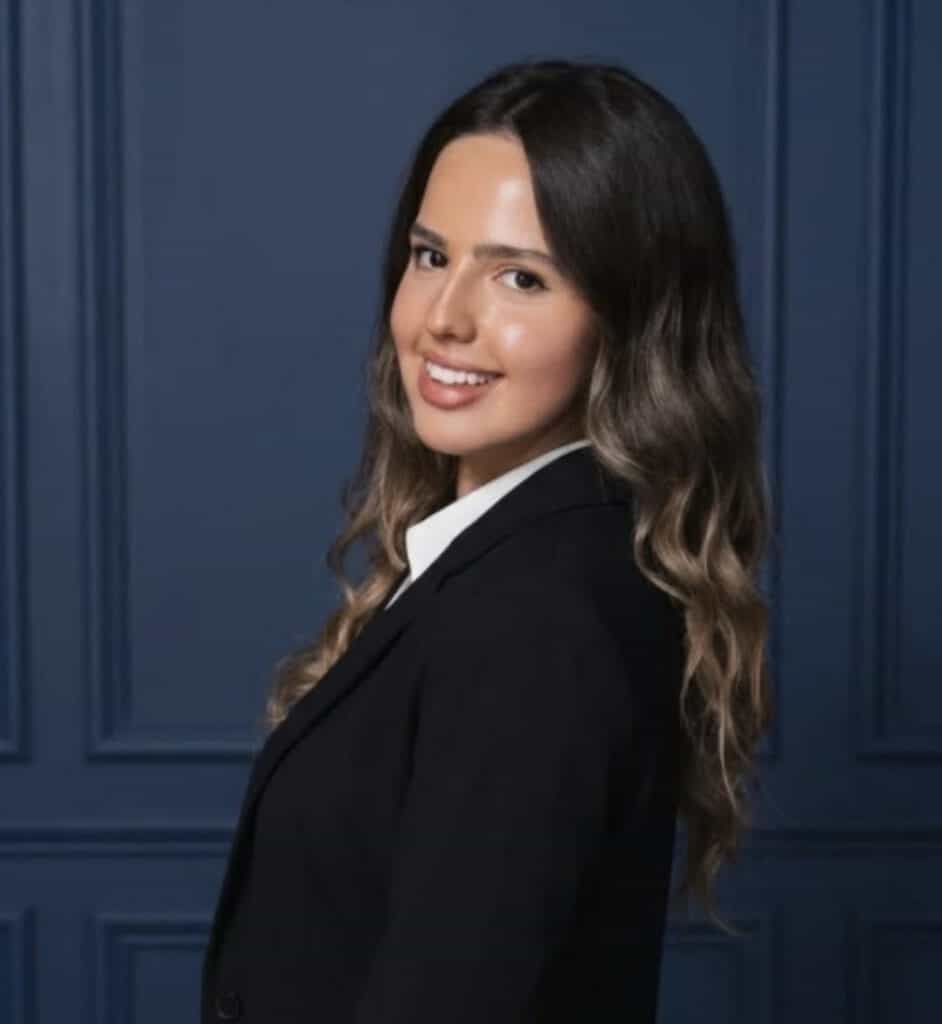
Anastasia Zorchinsky is a political science student at Concordia University in Montreal, a three-term elected Concordia Student Union councillor, the founder and co-president of StartUp Nation and a Student Journalism Intern with Rebel News. She is a plaintiff in ongoing litigation against Concordia University and its president Graham Carr.