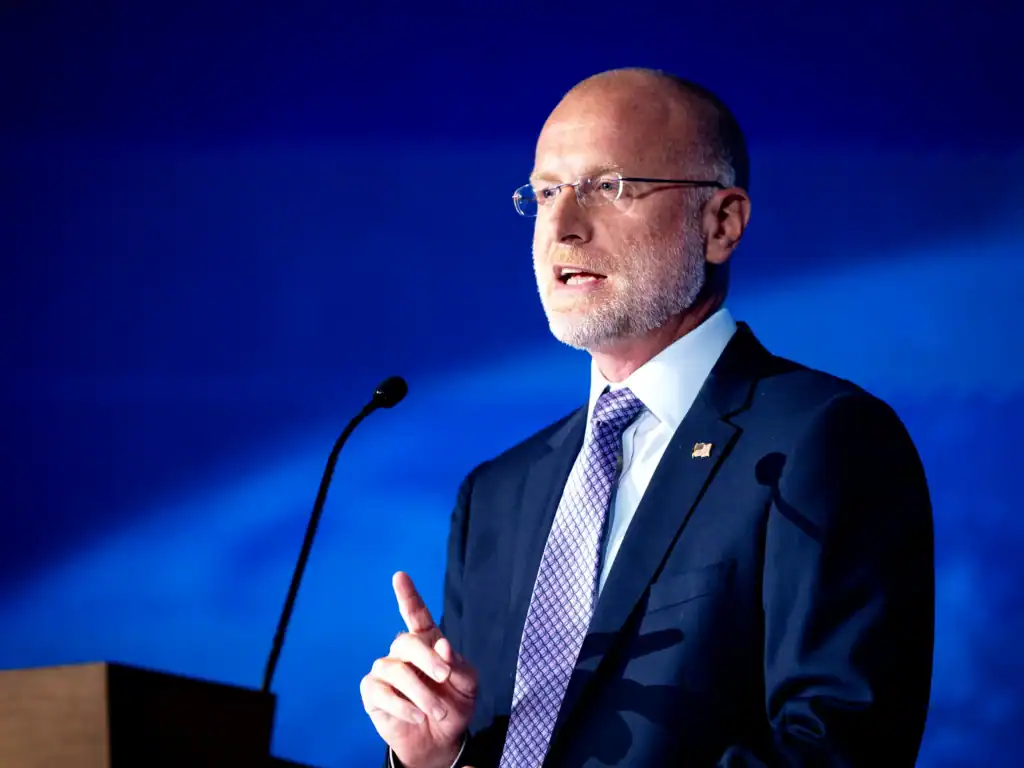
Brendan Carr has found himself at the center of multiple Texas- and Oscars-sized controversies as chair of the Federal Communications Commission (FCC).
Carr spoke with the Washington Reporter about his priorities, how his work at the FCC can complement President Donald Trump’s push for affordability, and how Democrats resort to disingenuous fundraising tactics when they complain about FCC censorship.
“We’re doing a lot,” Carr said, pointing to “a vote where there were actually rules on the books that required telecom providers to continue to invest billions of dollars, literally billions of dollars, into maintaining these aging copper line networks, even when they wanted to replace that copper with fiber or other high speed modern communications networks.”
“We finally adopted a decision to get rid of those outdated requirements for you to continue to maintain copper so you can free the way for dollars that can shift into new infrastructure bills,” Carr noted; that vote was a bipartisan 3-0 one at the FCC.
Another area of focus, Carr told the Reporter, is spectrum. “We do live streams and otherwise need a lot of airwaves, and during the Biden years, the FCC had simply fallen behind on freeing up spectrum, and we have just supercharged that effort,” Carr said. “We’re doing it two ways. One, existing entities that hold spectrum that aren’t necessarily putting it to a lot of use. We’ve been facilitating them moving that spectrum into the hands of people that will; we’ve got a big chunk going to AT&T right now. They’re seeing speeds increasing already. We got another big chunk going to Starlink. What they’re going to use is some really amazing stuff, including this new technology called direct to cell. Rather than going from your smartphone to the nearest cell tower can go right to a low Earth orbit satellite.”
Another reform is the FCC’s crackdown on robocalls, which Carr called a “huge annoyance to every American.” While progress has been made, he said that “we’re not raising the Mission Accomplished flag” yet.
More progress has been made with international call centers, which Carr explained can be both annoying and national security problems.
When Americans “call up a U.S. business,” he said, “they get frustrated when they get connected to a call center halfway around the world. There are language barriers, there are communications barriers, and there are also national security risks. You reach some of these call centers and you have people who are at legitimate call centers, but they get flipped by bad actors, and they end up getting paid off to illegally access your data, or they get trained in the legitimate call center, and then they go work at an illegitimate robocall operation somewhere else.”
Recently, “the FCC voted to encourage and to require the providers, at least if we regulate them via the FCC, which is a relatively small portion of all call centers, but the ones that we can regulate, to have them onshore some of those call centers,” he said. “Our idea here is pretty simple, which is that American callers should reach American call centers.”
The agency is also “doing permitting reform to accelerate internet infrastructure builds. We are boosting America’s space economy…We’re just going to keep the hammer down on those common sense issues.”
Not everything that Carr is doing is bipartisan. He is a frequent target of both elected Democratic politicians and their allies in the media, like Jimmy Kimmel and Stephen Colbert. However, Carr told the Reporter that “the claims, particularly from the left, about weaponization at the FCC are simply not true. We are applying the law in a fair and even handed way.”
Carr noted that Democratic politicians started weaponizing the FCC years ago.
“Weaponization has taken place at the FCC,” he said. “It did under the Biden years. When you look back, you had Senator Ed Markey, Senator Richard Blumenthal, write letters to the FCC calling for the agency to investigate Sinclair, which owns broadcast TV stations viewed by Democrats as being too conservative under the news distortion policy, the same policy they say that I shouldn’t be applying at all. They asked the FCC to apply to what they viewed as a conservative outlet. And after that letter came in, the company, Sinclair, had hundreds of routine licenses, broadcast TV licenses come up for renewal, the FCC approved, effectively, zero, maybe one got through. That had never happened before, the holding up broadly of licenses.”
“You also had members of Congress in the House write letters to cable companies pressuring them to drop entirely Fox News, OANN, and Newsmax from their cable lineups based on the political perspectives that they thought that those newsrooms were taking in,” Carr continued. “That’s not even broadcast TV where there is a public interest standard. It’s cable. There is no public interest standard, and that effort actually bore fruit. Some of those were actually dropped. You had Democrats in Congress pressure the FCC to block the sales of radio stations to buyers that they believed were too conservative. So we lived through this entire era, during the Biden years, of actual, legitimate weaponization by the FCC.”
“We have a choice,” Carr reflected about his possibilities. “We either do nothing right now, or we can at least not weaponize, but apply the law in an even handed way. That’s what we’re doing.”
One of the ways Carr has done that has been during America’s conflict with Iran. “President Trump has run directly at this idea that the legacy media gets to control what we think and what we say,” Carr said. “One feature that is broadcast television is just fundamentally different than any other form of distribution of programming. They have a license by the government, they have a public interest obligation, so that’s different than a cable channel or a streaming service or a podcast or a soapbox on the street, and yes, he has rules and regulations in place that govern how broadcasters are supposed to operate themselves. There’s a broadcast hoax prohibition, there’s a news distortion policy. You’re supposed to actually serve the needs of your local community, not necessarily whatever interests you may want to serve.”
One ambitious Democrat who publicly criticizes Carr is Gov. Gavin Newsom (D., Calif.) — which Carr thinks is because Newsom is “standing up for the billionaire liberal donors in Hollywood that simply don’t want the FCC to enforce the public interest standard anymore.”
Another priority of Carr’s ties into how Hill Republicans have defunded outlets like NPR, PBS, and CBS, and have taken on the “invidious” racism of DEI.
Following Trump’s anti-DEI executive orders, Carr’s FCC took action to follow suit against “deeply embedded” DEI policies in his agency.
“We had DEI advisory groups,” he said. “We had these digital discrimination regulations that the FCC had recently adopted. DEI was listed as the second highest strategic priority for the FCC. We’re the pipes and tubes agency. We’re supposed to be making sure that the internet’s getting out there, but we were listing DEI as our second highest strategic priority. So we ended all that on day one, or at least week one, and that’s been a good thing.”
The results have continued outside of his agency as well, he added. “We’ve had a lot of companies come forward to the FCC that we regulate, particularly when they’re trying to get transactions done, and agree to fully and finally eradicate invidious forms of DEI discrimination,” he said. “We’ve had AT&T do it. T-Mobile’s done it. Verizon has done it. Charter cable recently had a transaction, they’ve done it, Nexstar broadcaster that had a deal done, they’ve done it, so systematically, the businesses in the telecom sector that the FCC regulates are ending, not just in name, but in substance, their promotion of those invidious forms of DEI discrimination.”
Carr’s FCC is also working on an investigation into ABC’s program The View. “Congress passed a law many decades ago that said if you’re broadcasting, and if you have one legally qualified candidate for office on, you have to offer equal time, comparable time to all other opposing candidates,” he said. “Now the reason for that rule is that Congress didn’t want media gatekeepers to put a thumb on the scale in favor of one particular politician or one political party. There’s an exception to that rule, though, for programs that are called bona fide news programs. So if you’re a bona fide news program, you can get one candidate on, not the other, and the ideas that Congress had in mind at the time, things like Meet the Press or actual, real journalistic programs.”
But, he said, “Disney has been asserting that The View with Whoopi Goldberg and others, is a bona fide news program, and is therefore exempt from the FCC equal time rule. Our position has been, they’ve not established that they are qualifying for bona fide news. We’ve encouraged them to file a petition with the FCC, which is how this is normally done. If you want to be classified as bona fide news, file a petition with the FCC. We can then adjudicate that. But we have an enforcement matter going on right now because they have not been taking the steps that you otherwise would need to be if you were something other than a bona fide news program.”
While many Democrats are opposed to much of Carr’s agenda, some, like James Talarico in Texas, have been eager to use him as a fundraising tool.
But, Carr said, Talarico was being disingenuous in claiming that Trump and the FCC wanted an interview that the Texas Democrat did with Colbert to go un-aired.
“What happened in the Talarico incident was pretty funny,” Carr said. “I woke up one morning, and I opened up X, which is basically the first thing I do, like any good red blooded American, and I saw a tweet from the Talarico campaign that says, ‘this is the interview that Trump and his FCC don’t want you to see.’ It was the very first time I heard this. I had never heard about this. So, they falsely claimed at first that the FCC had refused to run the ad, as if we have some sort of dump button somewhere in the basement of the FCC. They think that we run down there and say, ‘these are MAGA airwaves. You can’t run that right now.’ So that never happened.”
“Then two, CBS itself later came out and said they also didn’t tell they couldn’t run the ad,” Carr noted. “They just said, ‘if you run it, there may be an equal time obligation that the relevant TV stations would have to follow.’ But rather than simply following the rules that have been on the books for 50, 60 years, they decided to run this hoax and falsely claim that they’d somehow been censored because they knew that the fake news media would eat it up..”
Part of Talarico’s success in turning the stunt into millions of dollars of donations was because of what has happened in late night comedy itself, Carr said.
“Something that’s gone really awry with these late night ‘comedy’ hosts is that it used to be that they were court jesters,” he said. “They would make fun of everybody. It was actually funny. And they’ve gone from being court jesters to court clerics, where they’re simply trying to enforce a very particular and narrow orthodoxy.”
Carr is hopeful he’ll find common ground with Democrats for America’s 250th birthday. “We’ve launched a Pledge America campaign at the FCC, where we’re encouraging broadcasters to run patriotic, pro-American content,” he said. “Go back through history, look at this day in history type of content, whether you can start the day with a Pledge of Allegiance when you open up the broadcast, we’re trying to encourage that level of patriotism to make a comeback across broadcasters.”
Carr himself likes the classics when it comes to patriotic programming. “Schoolhouse Rock is up there for me,” he said.
Below is a transcript of our interview with FCC Chair Brendan Carr, lightly edited for clarity.
Washington Reporter:
Why is it important for you to fly out to Texas to address CPAC as the Chair of the FCC?
FCC Chair Brendan Carr:
I’ve been to the last five or six CPACs; they’ve mostly been in D.C., which didn’t require a 3:30 a.m. wake up. But this is good as well, and it’s always just a lot of fun. You get to see so many people from across all sorts of different political movements, and it’s just great to get the chance to visit and catch up with folks.
Washington Reporter:
Let’s talk initially about how you were a subject of much consternation at the Oscars. Did you watch the Oscars?
FCC Chair Brendan Carr:
No, I didn’t have any trouble falling asleep that night, so I decided not to turn it on.
Washington Reporter:
Ahead of the Oscars, you infuriated a lot of the Oscar attendees and a lot of Democratic senators. Walk us through what you were telling broadcasters vis a vis this Iranian conflict that America has been in for about a month now.
FCC Chair Brendan Carr:
President Trump has run directly at this idea that the legacy media gets to control what we think and what we say. One feature that is broadcast television is just fundamentally different than any other form of distribution of programming. They have a license by the government, they have a public interest obligation, so that’s different than a cable channel or a streaming service or a podcast or a soapbox on the street, and yes, he has rules and regulations in place that govern how broadcasters are supposed to operate themselves. There’s a broadcast hoax prohibition, there’s a news distortion policy. You’re supposed to actually serve the needs of your local community, not necessarily whatever interests you may want to serve. I think for the last 10, 15, 20 years, the FCC completely walked away from enforcing that public interest obligation. We’re not better off as a country for it. Trust in legacy media is absolutely nosediving. It’s about 9 percent right now of people who trust the legacy media. What we’ve been doing is reminding broadcasters that there is, in fact, a public interest obligation. There are things that you can do for which you will lose your license. It’s a license. It’s not a property right. And there’s a lot of people that have difficulty with that. But what’s interesting to me is, the further you get away from the actual operation of a broadcast TV station, the more you see this sort of wailing and gnashing of teeth. Because the reality is, broadcasters that run these stations, they understand the FCC regulations. They understand they’ve been on the books for a long time. But these politicians that don’t run the TV stations that they hear about news distortion and broadcast hoax and public interest, and they get upset about it, particularly Gavin Newsom, who’s been very focused on the work that the FCC has been doing. And there’s a very easy explanation for that, which is that Governor Newsom isn’t standing up to me or standing up for any principle really, he’s standing up for the billionaire liberal donors in Hollywood that simply don’t want the FCC to enforce the public interest standard anymore, but on our watch, we’re going to do it. Again, it all comes from President Trump, because he just rejected this idea that the legacy media gets to control what we do, what we think. There are so many changes that are taking place. So you got NPR defunded, PBS defended, and at the FCC, we have investigations going into ABC, NBC, CBS, a number of others as well. We’ve got DEI investigations going on at places like Comcast. I think it’s a pretty good start.
Washington Reporter:
The FCC under your leadership has never been at a higher profile than it has been, maybe since the 1980s and telecoms wars. Which Democrats are you threatening with all of these changes?
FCC Chair Brendan Carr:
The energy that we’re bringing to the job all flows from President Trump and his direction to everyone that is working in the government. And we take our lead from the pace with which he is moving. And there’s a lot that we’re doing that again, is very different, and that you haven’t seen the FCC doing in probably 20 or 25 years. The claims, particularly from the left, about weaponization at the FCC are simply not true. We are applying the law in a fair and even handed way. But the weaponization has taken place at the FCC. It did under the Biden years. When you look back, you had Senator Ed Markey, Senator Richard Blumenthal, write letters to the FCC calling for the agency to investigate Sinclair, which owns broadcast TV stations viewed by Democrats as being too conservative under the news distortion policy, the same policy they say that I shouldn’t be applying at all. They asked the FCC to apply to what they viewed as a conservative outlet. And after that letter came in, the company, Sinclair, had hundreds of routine licenses, broadcast TV licenses come up for renewal, the FCC approved, effectively, zero, maybe one got through. That had never happened before, the holding up broadly of licenses. You also had members of Congress in the House write letters to cable companies pressuring them to drop entirely Fox News, OANN, and Newsmax from their cable lineups based on the political perspectives that they thought that those newsrooms were taking in. That’s not even broadcast TV where there is a public interest standard. It’s cable. There is no public interest standard, and that effort actually bore fruit. Some of those were actually dropped. You had Democrats in Congress pressure the FCC to block the sales of radio stations to buyers that they believed were too conservative. So we lived through this entire era, during the Biden years, of actual, legitimate weaponization by the FCC. There was a Fox broadcast TV, not even Fox News cable, but Fox broadcast TV station that came up for renewal in Philadelphia, and the Biden FCC didn’t renew it. They instead sought comment on a request to effectively revoke that license again over concerns about content that allegedly ran on a cable channel, yet separate from broadcast. So we’ve lived through massive weaponization at the FCC, and everybody who’s concerned now about what the agency is doing to simply actually apply the law in a lawful, even handed manner, was completely silent during those Biden years. In fact, many of the same people were ones that were encouraging the Biden administration do that. So in the future, Democrats will get the FCC again at some point. When they do, there is going to be massive weaponization. And so we have a choice. We either do nothing right now, or we can at least not weaponize, but apply the law in an even handed way. That’s what we’re doing.
Washington Reporter:
What does it mean that the FCC is investigating companies for DEI policies? Most people would be surprised to learn that the FCC has any sort of investigatory powers. Does this mean that you’re working with other Trump administration agencies, like the Department of Justice, on these, or is this all an in-house FCC investigation?
FCC Chair Brendan Carr:
It’s both. We’re working across other agencies that are focused on this, but we have our own rules and regulations on non-discrimination. When I came in, President Trump immediately issued an executive order ending the government’s promotion of invidious forms of DEI discrimination. We followed suit the very next day, ending the FCC’s own efforts to promote DEI.
Washington Reporter:
Can you remind people about the extent that DEI had pervaded the FCC?
FCC Chair Brendan Carr:
It was deeply embedded. We had DEI advisory groups. We had these digital discrimination regulations that the FCC had recently adopted. DEI was listed as the second highest strategic priority for the FCC. We’re the pipes and tubes agency. We’re supposed to be making sure that the internet’s getting out there, but we were listing DEI as our second highest strategic priority. So we ended all that on day one, or at least week one, and that’s been a good thing. And we’ve had a lot of companies come forward to the FCC that we regulate, particularly when they’re trying to get transactions done, and agree to fully and finally eradicate invidious forms of DEI discrimination. We’ve had AT&T do it. T-Mobile’s done it. Verizon has done it. Charter cable recently had a transaction, they’ve done it, Nexstar broadcaster that had a deal done, they’ve done it, so systematically, the businesses in the telecom sector that the FCC regulates are ending, not just in name, but in substance, their promotion of those invidious forms of DEI discrimination.
Washington Reporter:
One of the investigations that you had mentioned, it’s into The View on ABC, which my friend Chris Plante always notes is under the ABC News division. What is going on there?
FCC Chair Brendan Carr:
Well, it’s interesting. Congress passed a law many decades ago that said if you’re broadcasting, and if you have one legally qualified candidate for office on, you have to offer equal time, comparable time to all other opposing candidates. Now the reason for that rule is that Congress didn’t want media gatekeepers to put a thumb on the scale in favor of one particular politician or one political party. There’s an exception to that rule, though, for programs that are called bona fide news programs. So if you’re a bona fide news program, you can get one candidate on, not the other, and the ideas that Congress had in mind at the time, things like Meet the Press or actual, real journalistic programs. Now, flash forward to today. Disney has been asserting that The View with Whoopi Goldberg and others, is a bona fide news program, and is therefore exempt from the FCC equal time rule. Our position has been, they’ve not established that they are qualifying for bona fide news. We’ve encouraged them to file a petition with the FCC, which is how this is normally done. If you want to be classified as bona fide news, file a petition with the FCC. We can then adjudicate that. But we have an enforcement matter going on right now because they have not been taking the steps that you otherwise would need to be if you were something other than a bona fide news program.
Washington Reporter:
We are in Texas right now; you were used sort of unwittingly by James Talarico, who’s the Democratic nominee for Senate here. I’m wondering if you could take the wind out of the sails of other Democrats who would be interested in trying to repeat the James Talarico experiment with CBS News, and air a not funny interview with Colbert and then say that Brendan Carr prevented it from being aired. When they send those emails for fundraising, are they telling the truth?
FCC Chair Brendan Carr:
Something that’s gone really awry with these late night ‘comedy’ hosts is that it used to be that they were court jesters. They would make fun of everybody. It was actually funny. And they’ve gone from being court jesters to court clerics, where they’re simply trying to enforce a very particular and narrow orthodoxy. What happened in the Talarico incident was pretty funny. I woke up one morning, and I opened up X, which is basically the first thing I do, like any good red blooded American, and I saw a tweet from the Talarico campaign that says, ‘this is the interview that Trump and his FCC don’t want you to see.’ It was the very first time I heard this. I had never heard about this. So, they falsely claimed at first that the FCC had refused to run the ad, as if we have some sort of dump button somewhere in the basement of the FCC. They think that we run down there and say, ‘these are MAGA airwaves. You can’t run that right now.’ So that never happened. Then two, CBS itself later came out and said they also didn’t tell they couldn’t run the ad. They just said, ‘if you run it, there may be an equal time obligation that the relevant TV stations would have to follow.’ But rather than simply following the rules that have been on the books for 50, 60 years, they decided to run this hoax and falsely claim that they’d somehow been censored because they knew that the fake news media would eat it up. They knew that they would just unchecked run these stories saying that they censored. They knew they would get clicks and views and donations, and apparently they did. Kudos to them for an interesting campaign strategy, but really it was an indictment of the media, which didn’t take the time to realize that they were being played. What’s so funny is some of these journalists are not respected on the right because people view them as fake news and trust is down and their view is that they are just simply carrying water for Democrats. But they’re not respected on the left either, because their view is that they are just carrying water for Democrats.
Washington Reporter:
Of all of the scandals that you’ve found yourself in, where you’ve woken up and then found yourself in Democratic fundraising emails, the subject of alleged jokes at late night comedy, was there one that stood out to you as the most surprising?
FCC Chair Brendan Carr:
The Talarico one is probably it. If you’re not outraged about what I’m doing right now, just wait, there’ll be another outrage cycle. We’re running a great agenda at the FCC, and it’s outside the media space as well. We’re accelerating internet builds. We are helping to drive down prices for consumers. Look at prices for cell phone plans. Right now, they’re down something like six to 8 percent year over year, and down around eight percent off of Biden-era highs. We’re pushing to reshore call centers. We’re running a really aggressive agenda across the board. The media loves to talk about the media, and to some extent, it’s actually pretty convenient for me, because the media stuff we do is interesting. But it’s a small piece of what we do, really, but it’s all the media wants to talk about. So that gives us a lot of room to focus on other issues where the media isn’t getting it wrong.
Washington Reporter:
A couple of days ago, you announced the onshoring of and the reshoring of call centers. What does that mean, and what will that look like for Americans?
FCC Chair Brendan Carr:
We’re excited about this one. So many Americans now, when they call up a U.S. business, they get frustrated when they get connected to a call center halfway around the world. There are language barriers, there are communications barriers, and there are also national security risks. You reach some of these call centers and you have people who are at legitimate call centers, but they get flipped by bad actors, and they end up getting paid off to illegally access your data, or they get trained in the legitimate call center, and then they go work at an illegitimate robocall operation somewhere else. There are a lot of issues with it, and we’ve sought comment. Just this week, the FCC voted to encourage and to require the providers, at least if we regulate them via the FCC, which is a relatively small portion of all call centers, but the ones that we can regulate, to have them onshore some of those call centers. Our idea here is pretty simple, which is that American callers should reach American call centers. It’s been a really popular move, and we’re looking to see whether we can expand it even beyond the traditional telcos that we regulate. I think we’re going to work with other agencies on it, but it’s a really good initiative.
Washington Reporter:
And what does that interagency cooperation look like for you? You’ve been the chair of the FCC, and you were on it as a commissioner prior to this. What are the agencies in the administration that you find yourself working with the most, and who are the other chairs that you find yourself communicating with the most?
FCC Chair Brendan Carr:
There’s a lot of formal and informal talks. We all have really great relationships across the administration. Obviously, the FTC’s Chairman Andrew Ferguson does a lot of work similar to what we do at the FCC, and in the White House, we work with a lot of different components there. The National Economic Council is one that we’re most regularly in contact with. They’re sort of the hub; they help connect all the different economic agencies that are out there. The relationships across agencies right now is working really well.
Washington Reporter:
You were talking about how the FCC’s policies have led to phone bills going down in the Trump administration’s second term. What other ways have you seen this agency fitting in with the affordability push that we’re seeing from throughout the Trump administration?
FCC Chair Brendan Carr:
We’re doing a lot. This past week, we took a vote where there were actually rules on the books that required telecom providers to continue to invest billions of dollars, literally billions of dollars, into maintaining these aging copper line networks, even when they wanted to replace that copper with fiber or other high speed modern communications networks. We finally adopted a decision to get rid of those outdated requirements for you to continue to maintain copper so you can free the way for dollars that can shift into new infrastructure bills. Also spectrum. We do live streams and otherwise need a lot of airwaves, and during the Biden years, the FCC had simply fallen behind on freeing up spectrum, and we have just supercharged that effort. So we’re doing it two ways. One, existing entities that hold spectrum that aren’t necessarily putting it to a lot of use. We’ve been facilitating them moving that spectrum into the hands of people that will; we’ve got a big chunk going to AT&T right now. They’re seeing speeds increasing already. We got another big chunk going to Starlink. What they’re going to use is some really amazing stuff, including this new technology called direct to cell. Rather than going from your smartphone to the nearest cell tower can go right to a low Earth orbit satellite. You get high speed connectivity anywhere where you are. So we’re freeing up the spectrum that’s going to enable Starlink to do all these things, bringing more spectrum online, increases capacity, which drives down consumer prices at the end of the day.
Washington Reporter:
What you were just laying out is non-partisan. Do you think that Democrats will get on board with some of these policies, or is it because it’s coming from one of their top bogeymen in the administration and from Trump himself, they will want to throw roadblocks in your way on this?
FCC Chair Brendan Carr:
It’s a mixed bag. There’s some areas where we get really good, bipartisan consensus. For instance, at the FCC, we voted in a bipartisan vote in favor of those copper retirement rules. But there’s others, to your point, that even if it sounds like good, common sense policy, they can’t give a win to anyone who’s working for Trump or working in the Trump administration.
Washington Reporter:
At some point, Democrats will have a chair running the FCC. You’re dealing with a lot of technologies and a lot of policies that were written decades and decades and decades ago. Does Congress need to update these policies? Or do you want Congress to keep their foot off the gas pedal in terms of writing FCC policies, because you already have enough on books?
FCC Chair Brendan Carr:
Chairman Ted Cruz is the head of the Commerce Committee, which effectively oversees the FCC. He’s got some great pieces of legislation out that he’s working on, I think that’s always great for Congress to do it. There are different work streams going on underway right now. What’s funny right now is, you had so many activists on that left for years who were really happy with the FCC having expansive powers with this public interest standard that applied to broadcasters. They wouldn’t seek to apply it even handedly, they would seek to weaponize it. Now a lot of them are saying, ‘we don’t like what the current FCC is doing. Maybe we should rein in its powers.’ And frankly, I’m fine with that as well. If Democrats want to get together with Republicans and change the public interest standard or get rid of it, they should do that. And I’ll abide by that if Congress passes it and the president signs it, so we’ll see what they do on that front.
Washington Reporter:
And you’ve been in the political space for a while at this point; when did you see the shift from the left to the politicization that you were just laying out. Did this predate the first Trump term? Did you see this when Obama was president with his FCC?
FCC Chair Brendan Carr:
It’s always been there. It’s been sort of lumpy year to year, issue to issue. There’s some issues that are just bipartisan. There’s a lot the FCC does that people don’t care about, and rightly so. In the early 2000s we had a lot of debates at the FCC about media ownership regulations. Then we shifted and had about a 10 to 15 year debate on net neutrality. It’s amazing that the internet still works. After we repealed net neutrality, the left said that it was going to be literally. CNN had a headline that said, it was the end of the Internet as we know it. Well, you know, speeds went up, prices went down, digital divide narrowed.
Washington Reporter:
So, perhaps it was the end of the internet as we knew it, but not in the way they anticipated.
FCC Chair Brendan Carr:
Exactly right. So we go through phases at the FCC where there’s issues that break above the noise floor, and obviously it seems like we have had more of those in the last couple of years, but we’ve been through stuff like that before.
Washington Reporter:
We’re heading toward CPAC. You have several issues that you want to talk about with the audience here. What do you want to let the American people know that the FCC is working on?
FCC Chair Brendan Carr:
We’re working hard on robocalls. That’s a huge annoyance to every American. We’re actually doing some really innovative stuff to crack down on that; we’re not raising the Mission Accomplished flag on that. We’re doing permitting reform to accelerate internet infrastructure builds. We are boosting America’s space economy. There’s all the stuff that people know about the FCC right now, which is the media stuff. There’s all this other economic agenda that we’re running. And that’s why you’re seeing prices decline for cellphones, and speeds increasing. And we’re just going to keep the hammer down on those common sense issues.
Washington Reporter:
As we’re coming up on the 250th anniversary of America this year, there are lots of celebrations of that. What do you think that the Founding Fathers, as they were creating our country, would have thought about the existence of the FCC?
FCC Chair Brendan Carr:
That’s a great question. One thing that we’re doing in celebration of the 250th is we’ve launched a Pledge America campaign at the FCC, where we’re encouraging broadcasters to run patriotic, pro-American content. Go back through history, look at this day in history type of content, whether you can start the day with a Pledge of Allegiance when you open up the broadcast, we’re trying to encourage that level of patriotism to make a comeback across broadcasters.
Washington Reporter:
Is that something that used to happen?
FCC Chair Brendan Carr:
It still does. There’s a TV station ownership group located here in Texas that starts their broadcast day with the Pledge of Allegiance. You talk to people in D.C., and they think that’s strange and odd, but in other parts of the country, that level of patriotism within at least local broadcast TV, put national right to the side, is still there, and I think we just want to continue to encourage that to flourish, particularly this year.
Washington Reporter:
What is your favorite patriotic programming that you’ve ever watched?
FCC Chair Brendan Carr:
Well, you used to have even just the educational stuff, so Schoolhouse Rock is up there for me. Civics education right now is not in a great spot, so the extent that we can sort of reinvigorate some of that, I think that’s a good thing.
Washington Reporter:
Chairman Carr, a pleasure as always.