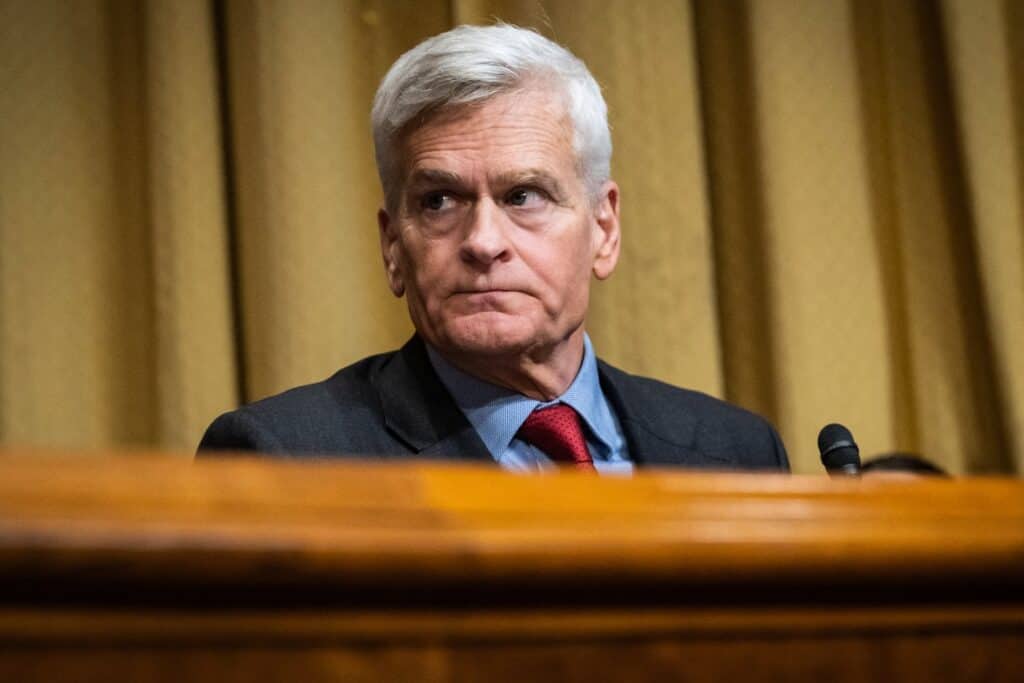
As chair of the Senate’s Health, Education, Labor and Pensions (HELP) Committee, Sen. Bill Cassidy (R., La.) — has ambitious plans for 2026, which includes tackling everything from pharmacy benefit manager (PBM) reform to lowering the costs of prescription drugs, all while investigating reports of federal childcare programs across the country.
Cassidy, who told the Reporter that he and President Donald Trump are “totally in sync” on a litany of health care policies, said that that remains the case, especially when it comes to “a potential deal for the exchanges.”
“The president wants the money to go to the patient, not the profit to the hospital,” Cassidy said. “Those are my words, but I think he would use them if he wanted to, and we are trying to come up with a plan that does that. As regards what we plan for the coming year, we’re going to have the hearing on misoprostol coming up. We’ll also try and do something on pharmacy benefit managers; the president is all about lowering the cost of prescription drugs. We had a bill that almost passed last year. We’ll try and bring it up again this year, which would lower premiums for people both in Medicare and in commercial insurance and as well as on the exchanges. It’s something across the board to benefit patients. The president’s going to be about that I know for sure, because he’s all about lowering the cost of prescription drugs.”
The Louisiana lawmaker was optimistic about the possibility of PBM reform, saying “I do” when asked if he thinks PBM reform can get done this year, and noted that “we had a bipartisan and a bicamerally bipartisan bill last year” on the issue.
“While I can’t promise you the timing of it,” he said, “we know we’re gonna have some major bills coming up. So maybe we’d want to hitch a ride or, if not as part of a bipartisan discussion about care. Clearly, PBM reform is something that’s up there, and we’re going to be looking for things that both parties can agree to.”
Cassidy wants to focus on “price transparency” as well and noted that “the president has thoroughly endorsed in the past, and we will be considering legislation on how to get that done.”
He also has several ideas about how Senate Republicans can lower health care costs for Americans, as Republicans work on lowering costs for Americans across a range of sectors. “The first is when you talk about the exchanges and giving people the option of having a health savings account and taking the credit that would be sent to the insurance company to lower their silver plan, but instead they have the opportunity to put that into a health savings account, that begins to deflect the cost of those premiums, and it begins to make the consumer more informed,” he said.
“If you couple that with price transparency,” Cassidy continued, “you’ve really unlocked the power of somebody having her own money to make a decision and to be motivated to make a decision based not just on quality, but also on price. And that begins to lower the cost from the provider. It also disintermediates the insurance company. If you’re paying the provider directly, you’re not going to the insurance company that takes 20 percent off the top for profit and overhead. So I think in a lot of ways, we can squeeze some of the wasted money out of the system, benefiting mostly the patient, but also the provider.”
While that reform is bad news for insurance companies, he said that “the insurance companies are still going to make their money. They just won’t make as much money because a certain amount of it’s going to the health savings account.”
Cassidy explained price transparency with a hypothetical in which someone might need coverage from an out-of-network provider.
“Let’s assume that the hospital bill’s $100,000,” he said. “The insurance company pays them $20,000. The insurance company, though, would bill the employer $60,000 for something that they only paid $20,000 for. They say, ‘oh, we knocked them down from 100 to 60,’ when in reality, they’re still pocketing $40,000…We want to make it so that it’s actually known what is being paid and what is being charged, and that way, if somebody is getting having the expenses padded, effectively being ripped off, feeling that somebody’s acting as their fiduciary but actually the person’s acting to line their own pockets, that can be exposed, and that practice ended.”
Cassidy also wants to investigate some issues GOP voters are concerned with across the country. In the coming days, he’ll hold a hearing on the abortion drug misoprostol. The pro-life lawmaker, whose recent endorsement from the Susan B. Anthony Pro-Life America Candidate Fund was first covered by the Reporter, explained that he’s pro-life because “I’m a physician, and you just go back to how you studied the growth of a child within the womb, and you understand that there was a life there, and you do things recognizing that it is life.”
With misoprostol, he said, “here you have something which is increasingly the preferred means of having an abortion, and there are concerns that, as in Louisiana, there was a young girl coerced by her mother to take the pill, and the doctor never saw the patient, never had the chance to say, ‘do you really want this?’ They just sent it through the mail, and there’s now a lawsuit pending on this.”
“That’s wrong,” he continued, “and we need to have oversight as to how this is being implemented. And I think this is appropriate. I don’t see why people are against that. And if there’s negative health effects, those should be known.”
Cassidy also said that hearings are coming from his committee — and potentially from others, like the Financial Services Committee — into reports of widespread fraud in state-based Medicare, Medicare, and childcare programs that receive federal dollars.
While “the HELP Committee does not have jurisdiction over Medicaid and Medicare,” he said, “we do have jurisdiction over the childcare setting and some of those programs, and we are absolutely going to have hearings.”
Cassidy’s work could help other lawmakers to look into high-profile instances of health care fraud like what appears to be happening under the watch of Gov. Tim Walz (D., Minn.). “Now that said, the same approach that could address fraud in childcare settings could also address fraud in other settings. Around 10 to 15 percent of Medicaid spending is estimated to be spent on fraud. That number kind of rings true to me. So, how do you cut it out? Well, first you’ve got to figure out what is the nature of the fraudulent service. And it’s easy to imagine that sometimes, either the patient does not exist or that the services rendered are padded. Now we don’t know that for sure. Senate Finance, I suspect, will hold some hearings on that, but I think technology that addresses one could address the other. For example, requiring biometric confirmation, or some other confirmation that the person having services actually was there to receive the services.”
Biometric confirmation is something that Louisiana Republicans have led on, he added, since at least the days of Gov. Bobby Jindal (R., La.), who paved the way for accountability in a childcare system that had been rife with fraud. “Under Governor Bobby Jindal, we put in a system where we required a thumb swipe or a finger swipe when somebody dropped off a child at a daycare center, and when you pick them up, you swipe the finger again. It’ll be the adult, not the child, swiping the finger. But that was a document that a child had been dropped off and picked up, and that when the system was put in, people thought that something’s wrong with the software.”
“Why is that?” he asked. “Because thousands of kids are suddenly not showing up. Well, it turns out that thousands of kids didn’t exist, and there’s been charges rendered for these services, even though the child did not exist, and they saved $3 million a month…The federal taxpayer needs to make sure that states are making sure that if somebody is actually receiving reimbursement from a child enrolled at their school, that there’s actually a child enrolled in their school. And we know that the technology exists to do this unobtrusively, to collect the data simply, I’m told the data that was being used in Louisiana is now being used in 17 states. Okay, what are the other 33 states doing? Thirty-four if you include D.C., are they doing a different type of system, or no system at all? In Minnesota, apparently they’re doing no system at all.”
Finally, Cassidy had a “great story” about how he’s used the One Big, Beautiful Bill (OBBB) to help small business owners across his state. “There’s a guy who owns some haircut stores, Jeremy Aydell, and he heard we were going to exempt tips for waiters and bartenders, and he calls up and says, ‘wait a second. Why not exempt tips for people who wash your hair and cut your hair?’” he said. “And Jeremy has a point, and because Jeremy called my team, now those people doing your hair and beauticians are included in those who don’t pay tax on tips. So there’s a lot of folks in my state that do that. I also want to say, that’s a great example of representative government, where somebody being represented calls up and says, ‘what about me?’ And it turns out they’ve got a good argument, and they were included; that’s really a positive thing.”
More broadly, the GOP’s OBBB will help Louisiana seniors and people working overtime; both groups are poised to score major tax returns this tax season.
“We’ve got one of the world’s largest construction projects with Venture Global, in my state. Those create great paying jobs, jobs that contribute to pension plans, to union plans, to create full time employment for everybody that’s going to service those facilities.”
Below is a transcript of our interview with Sen. Bill Cassidy, lightly edited for clarity.
Washington Reporter:
Senator Cassidy, a couple of weeks ago you told me that you and President Trump are “totally in sync” on healthcare policy. Is that still the case as you figure out what you want the GOP’s healthcare roadmap to look like in 2026?
Sen. Bill Cassidy:
Well, you got a lot in there, so let’s unpack it a little. Speaking specifically about a potential deal for the exchanges, the president wants the money to go to the patient, not the profit to the hospital. Those are my words, but I think he would use them if he wanted to, and we are trying to come up with a plan that does that so. As regards what we plan for the coming year, we’re going to have the hearing on misoprostol coming up. We’ll also try and do something on pharmacy benefit managers; the president is all about lowering the cost of prescription drugs. We had a bill that almost passed last year. We’ll try and bring up again this year, which would lower premiums for people both in Medicare and in commercial insurance and as well as on the exchanges. It’s something across the board to benefit patients. The president’s going to be about that I know for sure, because he’s all about lowering the cost of prescription drugs. We have a couple other things, like price transparency which the president has thoroughly endorsed in the past, and we will be considering legislation on how to get that done. That’s a nice beginning of the list.
Washington Reporter:
What do you think would need to happen for the PBM reform to get done this year? This has been something that you’ve led the way on, fighting for transparency and prescription drug prices for a while at this point. But do you think that this is the year with Republican Congress and with Trump wanting to work with you on this that it can actually get over the finish line?
Sen. Bill Cassidy:
I do because we had a bipartisan and a bicamerally bipartisan bill last year, so I do think that we can, and while I can’t promise you the timing of it, except that we know we’re gonna have some major bills coming up. So maybe we’d want to hitch a ride or, if not as part of a bipartisan discussion about care. Clearly, PBM reform is something that’s up there, and we’re going to be looking for things that both parties can agree to.
Washington Reporter:
You were just also mentioning a hearing that you’re having in a couple of days about abortion drugs. Why is that an important priority for you as a pro-life legislator to do as chair of HELP?
Sen. Bill Cassidy:
I’m a physician, and you just go back to how you studied the growth of a child within the womb, and you understand that there was a life there, and you do things recognizing that it is life. Here you have something which is increasingly the preferred means of having an abortion, and there are concerns that, as in Louisiana, there was a young girl coerced by her mother to take the pill, and the doctor never saw the patient, never had the chance to say, ‘do you really want this?’ They just sent it through the mail, and there’s now a lawsuit pending on this. That’s wrong, and we need to have oversight as to how this is being implemented. And I think this is appropriate. I don’t see why people are against that. And if there’s negative health effects, those should be known.
Washington Reporter:
Another topic that you’ve been spotlighting as chairman is how insurance companies use tax credits to pad profits and not lower costs for consumers. How does everything that you’re working on fit into that? And how would it stop that from happening in the future?
Sen. Bill Cassidy:
Two things about that: The first is when you talk about the exchanges and giving people the option of having a health savings account and taking the credit that would be sent to the insurance company to lower their silver plan, but instead they have the opportunity to put that into a health savings account, that begins to deflect the cost of those premiums, and it begins to make the consumer more informed. If you couple that with price transparency, you’ve really unlocked the power of somebody having her own money to make a decision and to be motivated to make a decision based not just on quality, but also on price. And that begins to lower the cost from the provider. It also disintermediates the insurance company. If you’re paying the provider directly, you’re not going to the insurance company that takes 20 percent off the top for profit and overhead. So I think in a lot of ways, we can squeeze some of the wasted money out of the system, benefiting mostly the patient, but also the provider. The insurance companies are still going to make their money. They just won’t make as much money because a certain amount of it’s going to the health savings account. That’s number one. There’s another thing we’ve been working on that would build upon previous legislation that would require that hospitals report in machine readable files how much they are charging for certain procedures. Why is that important? Because there’s an article in the Wall Street Journal from maybe a year ago now, about how when a patient goes to an out of network provider. Let’s assume that the hospital bill’s $100,000. The insurance company pays them $20,000. The insurance company, though, would bill the employer $60,000 for something that they only paid $20,000 for. They say, ‘oh, we knocked them down from 100 to 60,’ when in reality, they’re still pocketing $40,000. Now, I’m making those numbers up, but that article was in the Wall Street Journal, and you can find the exact numbers, and they’re pretty impressive. We want to make it so that it’s actually known what is being paid and what is being charged, and that way, if somebody is getting having the expenses padded, effectively being ripped off, feeling that somebody’s acting as their fiduciary but actually the person’s acting to line their own pockets, that can be exposed, and that practice ended.
Washington Reporter:
One of the other areas that you’ve been working on that’s very much in the zeitgeist right now is fighting fraud in the healthcare system. We’re seeing these videos in Minnesota with the “Learning Center” and others. But there’s also Medicaid-linked fraud going on in Minnesota and potentially in many other blue states around the country. Is this something that you think the HELP Committee should look into?
Sen. Bill Cassidy:
The HELP Committee does not have jurisdiction over Medicaid and Medicare. We do have jurisdiction over the childcare setting and some of those programs, and we are absolutely going to have hearings. Now that said, the same approach that could address fraud in childcare settings could also address fraud in other settings. Around 10 to 15 percent of Medicaid spending is estimated to be spent on fraud. That number kind of rings true to me. So, how do you cut it out? Well, first you’ve got to figure out what is the nature of the fraudulent service. And it’s easy to imagine that sometimes, either the patient does not exist or that the services rendered are padded. Now we don’t know that for sure. Senate Finance, I suspect, will hold some hearings on that, but I think technology that addresses one could address the other. For example, requiring biometric confirmation, or some other confirmation that the person having services actually was there to receive the services.
Washington Reporter:
The House Oversight Committee was focusing on Minnesota specifically. But from the hearings that you’re thinking about looking at from the childcare standpoint, would you want to focus on just Minnesota or be broader in the states that you’re looking into?
Sen. Bill Cassidy:
We need to look across the nation. Louisiana had a system, and we’ll tell you some stuff which I’m investigating, but the sources tell me this is reliable. Under Governor Bobby Jindal, we put in a system where we required a thumb swipe or a finger swipe when somebody dropped off a child at a daycare center, and when you pick them up, you swipe the finger again. It’ll be the adult, not the child, swiping the finger. But that was a document that a child had been dropped off and picked up, and that when the system was put in, people thought that something’s wrong with the software. Why is that? Because thousands of kids are suddenly not showing up. Well, it turns out that thousands of kids didn’t exist, and there’s been charges rendered for these services, even though the child did not exist, and they saved $3 million a month. During COVID, that was stopped. I think basically they bailed out the childcare centers and the number of kids being enrolled in these child care centers doubled. It’s not been reinstituted, I’m told, and now the number of kids being enrolled in the centers has increased even more. Now maybe that eligibility has expanded, but Louisiana’s population hasn’t grown. So you’ve got to go back and make sure. The federal taxpayer needs to make sure that states are making sure that if somebody is actually receiving reimbursement from a child enrolled at their school, that there’s actually a child enrolled in their school. And we know that the technology exists to do this unobtrusively, to collect the data simply, I’m told the data that was being used in Louisiana is now being used in 17 states. Okay, what are the other 33 states doing? Thirty-four if you include D.C., are they doing a different type of system, or no system at all? In Minnesota, apparently they’re doing no system at all.
Washington Reporter:
Speaking of something that Louisiana is leading on, I don’t know if you know this, but Labor Secretary Lori Chavez-DeRemer loved her visit with you to the gator farm as part of the One Big, Beautiful Bill tour that she’s doing across the country. Can you talk about how that bill has been helping your state, and how you see working with the Trump administration?
Sen. Bill Cassidy:
I have a great story about that. There’s a guy who owns some haircut stores, Jeremy Aydell, and he heard we were going to exempt tips for waiters and bartenders, and he calls up and says, ‘wait a second. Why not exempt tips for people who wash your hair and cut your hair?’ And Jeremy has a point, and because Jeremy called my team, now those people doing your hair and beauticians are included in those who don’t pay tax on tips. So there’s a lot of folks in my state that do that. I also want to say, that’s a great example of representative government, where somebody being represented calls up and says, ‘what about me?’ And it turns out they’ve got a good argument, and they were included; that’s really a positive thing. So we’ve got a great story there. We’ve got a lot of people working overtime in my state. We’ve got a lot of senior citizens. You put it all together, and there’s a lot of people benefiting. My state will be doing lots of that for a variety of reasons, and I want that boom to take off. We’ve seen some of it already. We’ve got one of the world’s largest construction projects with Venture Global, in my state. Those create great paying jobs, jobs that contribute to pension plans, to union plans, to create full time employment for everybody that’s going to service those facilities. So the One Big, Beautiful Bill promoting capital investment in the United States is going to benefit my state.
Washington Reporter:
We also need to get no tips for gator farmers, because that sounds like a job more dangerous than you or I have.
Sen. Bill Cassidy:
The guy taking us on the tour could have been an independent contractor, and so they actually do live on tips, and they would actually benefit from the no tax on tips.
Washington Reporter:
That’s a great point, senator. Thanks as always for chatting.