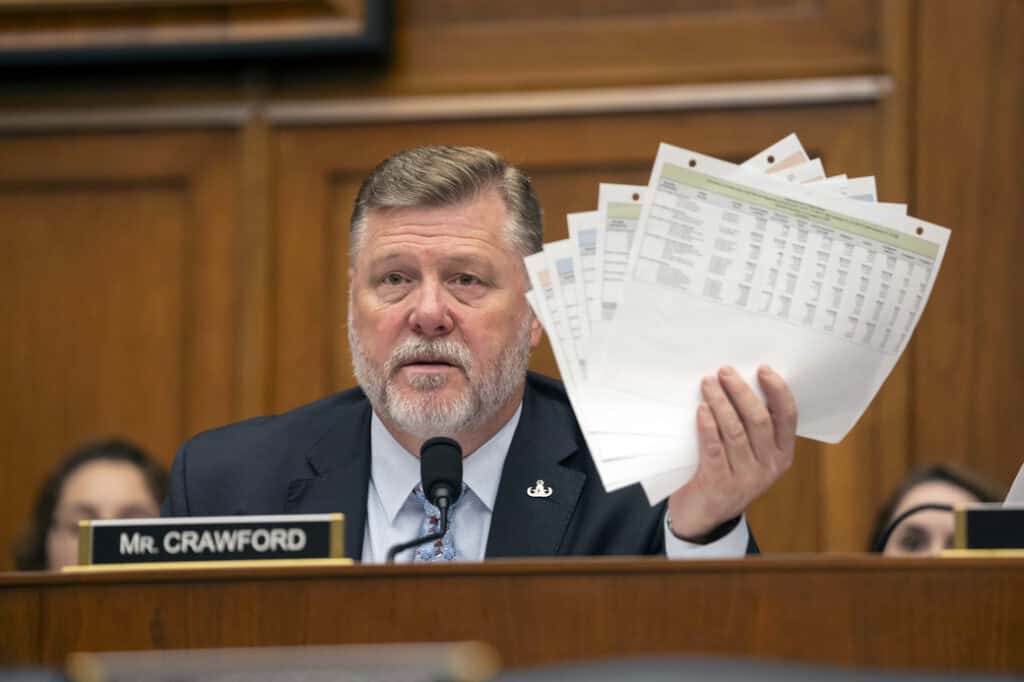
In November, Crawford told the Reporter in a separate interview why drone striking alleged drug boats coming from Venezuela fits in with an America First foreign policy. “The statement is bigger than the cartels,” he said at the time. “It is about regional security. It’s about making sure that the Western Hemisphere is not a playground for the Chinese, for the Russians, for the Iranians. And I think that this show of force is that statement.”
Trump’s latest moves in the Western Hemisphere fit that mold, he explained. “This is our neighborhood,” he said. “We live here. And something I’ve learned over the years is that you don’t want to be the best house in a bad neighborhood. If anything, you’d rather be the worst house in a good neighborhood. And what we’re trying to do is improve the neighborhood. We’ve got things to do to our own house, but the reality is, we want to secure our neighborhood, and that’s what this is about.”
“This is absolutely making America great again, and it is America First to be a partner with the allies in the neighborhood who recognize the need for leadership and they don’t want to see safe operating space for cartels or international crime syndicates,” he said. “They don’t want to see the economic conditions that are such that they’re put under pressure from countries like China. They don’t want to see countries like Iran carving out a niche in our hemisphere; same with Russia and everything that that implies. Russia has been here in the Western Hemisphere for a long, long time. And it’s time that we started taking this seriously. And I think our allies recognize that, and that’s why this has been lauded really up and down the hemisphere.”
Crawford does “not necessarily” know what will come next for Venezuela.
“There’s a lot of talk about what role the United States government will play in trying to ensure a transition from Maduro to the next government,” he noted. “But the fact is, he was not a legitimate president, but he was still running the country, and his vice president, early on, almost immediately, stated that Maduro is the president and that he’s legitimate. She has since softened her tone and her rhetoric is changing because she knows there are a lot of politicians that are like this. They don’t really have a true North. They’re going to decide whichever way the wind’s blowing the strongest, that’s what they’re going to do. And it looks like for her own political future, she may go on ahead and reconfigure and say maybe it’s not such a bad idea to work with Americans and see if we can’t reinstall a democratic process, which Venezuela was.”
More broadly, Crawford pointed to what he’s termed the “Communist Triad of the Western Hemisphere”: Venezuela, Cuba, and Nicaragua. “They’re all flailing,” he said, “and it’s all because they have the wrong political ideology and a flawed model of governance. And wherever you see communism in place, you see desperation, you see a flailing economy, you see poor outcomes, you see the lack of self determination for people. And this can change, and it probably will, now that Maduro is gone.”
“With Venezuela on its way to reform,” he continued, “this means that Cuba will be fairly closely following because we’re cutting off the oil to Cuba, and that was their lifeline. And there are opportunities for us to do some other things diplomatically in Venezuela that will also negate the need for Cuba’s quote, unquote health care professionals…The propaganda that they put forward about their health care prowess is so ridiculously overstated, it’s not even funny. And the fact that they’ve basically duped Latin American countries into thinking that they were the preeminent healthcare providers in the world is a joke. And now we’ve seen Venezuela’s healthcare system as it is, deteriorating so fast that they’re going to need some help, and they’re going to need it soon, because of the health issues that they’re dealing with right now. The Cubans aren’t going to be able to help them. They’re not in position to do it. And I think that’s an opportunity for us to really shine.”
When it comes to other threats facing the homeland, Crawford noted Trump’s work on border security as important. Beyond that, he added that “we’re obviously going to have to engage more aggressively, diplomatically, economically in our hemisphere; there’s great opportunities for us to do that. I see some huge potential now in Venezuela, but Honduras and Guatemala are two countries that come to mind, and El Salvador as well where they’re the sky’s the limit on what we could do to create economic opportunities, not only for the United States and investors here at home, but also for those individuals in the Northern Triangle where you’ve historically seen a lot of immigration and irregular migration taking place.”
“We’ve really got to redouble our efforts on counterintelligence,” he said. “That’s a huge, huge issue here at home, because it’s not just about one off bad actors. It’s about the systemic violation of our open society that’s taking place by countries like China and Russia, who know our open society very, very well. They know how to exploit it, and we need to do a much better job across the CI enterprise and really protect the homeland on the CI front.”
Below is a transcript of our interview with Rep. Rick Crawford, lightly edited for clarity.
Washington Reporter:
Chairman Crawford, what can you tell me about the run up to this operation and the aftermath of it? What have you learned about the U.S.’s military capability, and what can you tell us about this operation that nabbed Maduro in the middle of the night?
Rep. Rick Crawford:
I’m going to separate the two: the U.S.’s military operation and capabilities are nothing that I didn’t already know in terms of our capabilities and in terms of what our military was capable of under very difficult circumstances. This particular element is particularly adept at these types of operations, and you don’t hear from them a lot. They’re not out there running for the microphones and trying to get book deals, because they’re out there doing their job and they’re the quiet professionals that we hear so much about, but we very seldom see in action. Their capability to provide the level of support that was necessary for DOJ to take the action that they took is phenomenal. So having said that, now separating the military capability, let’s look at it from the Department of Justice perspective; this was an execution of a warrant for a suspect who was a fugitive from justice in the United States. He was under indictment in the Southern District of New York. Many people don’t know that his wife was also under a sealed grand jury indictment, so that’s why she was taken into custody as well. And by the way, FBI and other federal law enforcement elements were present, and those two individuals were Mirandized on the scene, and then they were taken into custody and extracted, taken to the Iwo Jima and then subsequently they found their way to the jailhouse in Brooklyn, and they have already been in front of a judge. This all took place in a very short span of time. The actual operation is the result, however, of days, weeks, months, years of preparation, as well as long term strategic intelligence on Venezuela. It required operational understanding and putting that into practice at a tactical level so that they could execute. This didn’t happen overnight. They had not only to have the adequate intelligence to be able to act, but they also had to have the weather. Everything had to be perfect. They had to not only have the appropriate weather, but also be sure beyond a doubt that the individuals in question were where they were supposed to be at the time they were supposed to be, so that they could act accordingly, and then all those assets came together at the right time. We had a remarkable execution of a very well planned operation that was a result of, actually, years of understanding of Venezuela.
Washington Reporter:
In the past you explained to us in a different interview how the drone strikes on the Venezuelan drug boats fit in with an America First foreign policy. Can you give us your thoughts on how this even bigger step fits in with your view of the Western Hemisphere?
Rep. Rick Crawford:
This is our neighborhood. We live here. And something I’ve learned over the years is that you don’t want to be the best house in a bad neighborhood. If anything, you’d rather be the worst house in a good neighborhood. And what we’re trying to do is improve the neighborhood. We’ve got things to do to our own house, but the reality is, we want to secure our neighborhood, and that’s what this is about. This is absolutely making America great again, and it is America First to be a partner with the allies in the neighborhood who recognize the need for leadership and they don’t want to see safe operating space for cartels or international crime syndicates. They don’t want to see the economic conditions that are such that they’re put under pressure from countries like China. They don’t want to see countries like Iran carving out a niche in our hemisphere; same with Russia and everything that that implies. Russia has been here in the Western Hemisphere for a long, long time. And it’s time that we started taking this seriously. And I think our allies recognize that, and that’s why this has been lauded really up and down the hemisphere. And there may be some folks in other countries who are looking at this through a political lens, but the reality is, we finally have a president who’s taking security seriously, and it is very much a decidedly America First agenda, because we’re trying to secure our neighborhood.
Washington Reporter:
You were talking about the positive reception that this has received from our allies in the region. Can you talk a little bit more about what you think this is saying to China, to Iran, to Russia about what America is signaling for the year 2026 and beyond?
Rep. Rick Crawford:
This is a very, very strong signal to all of those three — Russia, Iran, China — that we are not taking our eyes off of our neighborhood anymore. The Global War on Terror has gone on for 20 odd years, and look, the Global War on Terror continues. We’re still dealing with threats associated with Islamist terror groups; that probably will continue. I’d love to see that eradicated in our lifetime. I’m not sure that we ever will, but I hope so, and we’ll continue that effort, but not at the expense of the security here at home, and that means that we’ve got to cast a wider net here and keep our eyes open with what’s taking place here in the Western Hemisphere, and as we left this neighborhood unguarded to go forward and prosecute the War on Terror, we left our allies kind of unprotected, and that opened up opportunities for countries like China and Russia. China probably has been the most aggressive in the last 20 years. Russia has been around for a long, long time. China has really sought to displace the United States in our own hemisphere through a variety of methods, like with infrastructure investment, debt trap diplomacy, and the various methods that they use, all in the hopes that they might be able to ultimately get enough support from a given region that they might be able to maybe create another base, much like what they have in Djibouti, right here in the Western Hemisphere. It was very much in our interest to throw down a marker and say ‘not anymore.’ We’ve heard the term the Trump Corollary of the Monroe Doctrine; some people are now calling it the Donroe Doctrine. But whatever you want to call it, it’s long overdue. I’ve been calling for this for eight years, ever since I’ve been on the Intel Committee; we have assigned areas of responsibility for each member. And I asked for the Western Hemisphere, because I saw this as a real problem for us. And to me, this is all music to my ears. I am thrilled to see that the president has made this a priority. As chairman of the Intel Committee, when I came in a year ago, I said that this is going to be my priority. And I was very delighted to see that the president shared that view. We have stood up a Western Hemisphere action cell on the Intel Committee that is focused on keeping our eyes on this problem set in the Western Hemisphere. I’ve traveled extensively in the Western Hemisphere. I have brought other members with me; most recently, I traveled to Honduras as an election observer because it’s important that we show not only our allies in the hemisphere but countries around the world that we are going to be present and that we’re going to do everything we can to support our allies in whatever way that is necessary. And the president supported that; we got a favorable outcome in terms of what you’re seeing politically taking place in the hemisphere right now is a strong rebuke of communism. The irony is, for some unexplained reason, but this will correct itself, I’m sure, for whatever reason, the voters in New York City decided to elect a communist. He can call himself a Democratic socialist if he wants to. But what we know is that’s what they called themselves in East Germany, but they were communists nonetheless. Whenever you want to try and soften it up through some different title, it’s still communism. It won’t work. It’s proven to fail every time, and it certainly won’t work here in the United States. New York City is in for a tough road going forward, but for the rest of the Western Hemisphere, we’re seeing exactly how they feel about communism, because it’s being roundly rebuked, from Peru to Chile to Argentina to Honduras most recently. I expect we’ll see the same thing in Colombia, and we’re seeing it in Venezuela. I don’t know when the folks in New York City are going to get the memo, but I hope it’s sooner rather than later. But you get what I’m saying here: communism is not welcome in the Western Hemisphere.
Washington Reporter:
Do you have a sense of what you want Venezuela to look like?
Rep. Rick Crawford:
Not necessarily. But I’ve got a few ideas. There’s a lot of talk about what role the United States government will play in trying to ensure a transition from Maduro to the next government. But the fact is, he was not a legitimate president, but he was still running the country, and his vice president, early on, almost immediately, stated that Maduro is the President and that he’s legitimate. She has since softened her tone and her rhetoric is changing because she knows there are a lot of politicians that are like this. They don’t really have a true north. They’re going to decide whichever way the wind’s blowing the strongest, that’s what they’re going to do. And it looks like for her own political future, she may go on ahead and reconfigure and say maybe it’s not such a bad idea to work with Americans and see if we can’t reinstall a democratic process, which Venezuela was. Prior to Hugo Chavez, the institutions of democracy and self determination were strong, until Hugo Chavez got in there, and it really changed the course of history for Venezuela. And then, of course, the bus driver, Maduro, was able to ascend to that position. And it’s been an amazing transformation of a country that is perhaps the most mineral wealthy on a pound for pound basis. On a square mile basis, they probably are the most mineral wealthy nation on the planet in a variety of different categories, with oil obviously being one. But there are others, like rare minerals, and there’s really no reason at all for them to be struggling economically, except to say that their political system doesn’t comport with having a strong economy. You can point to several nations, like Cuba most notably, but also to Nicaragua. I call these countries the Communist Triad of the Western Hemisphere: Venezuela, Nicaragua, and Cuba. They’re all flailing, and it’s all because they have the wrong political ideology and a flawed model of governance. And wherever you see communism in place, you see desperation, you see a flailing economy, you see poor outcomes, you see the lack of self determination for people. And this can change, and it probably will, now that Maduro is gone. The expat community in South Florida has been ecstatic about this, and it turned out in huge numbers, the expat community in other parts of the world, in the hemisphere where you had Venezuelans in significant number, who have fled the country because of Maduro’s oppression, are now openly lauding this victory for Venezuela and for the United States. In fact, I’ll give you an example that’s close to home. There’s a nurse who works up close to me here at a hospital close where I live right here in my hometown. I’ve already heard from her about what a great day this was, and she’s a very well known nurse up there at this hospital, and she’s from Venezuela, and she was just ecstatic. And she has shared that with everybody in the hospital. With Venezuela on its way to reform, this means that Cuba will be fairly closely following because we’re cutting off the oil to Cuba, and that was their lifeline. And there are opportunities for us to do some other things diplomatically in Venezuela that will also negate the need for Cuba’s quote, unquote health care professionals. That’s a remote tour, by the way, for these Cuban doctors. I don’t know if I’ve told you this or not, but I’ve been to Cuba many, many times. I actually took a medical mission to Cuba some years back. The propaganda that they put forward about their health care prowess is so ridiculously overstated, it’s not even funny. And the fact that they’ve basically duped Latin American countries into thinking that they were the preeminent healthcare providers in the world is a joke. And now we’ve seen Venezuela’s healthcare system as it is, deteriorating so fast that they’re going to need some help, and they’re going to need it soon, because of the health issues that they’re dealing with right now. The Cubans aren’t going to be able to help them. They’re not in position to do it. And I think that’s an opportunity for us to really shine. On the other hand, the idea that you’ve got these people in New York City who have nothing more to do than to engage in activism, they don’t even know what they’re protesting against. It’s really kind of sad and somehow trying to weave in an anti-Semitic message while they’re at it shows that this is such a sad bunch of people, and at some point in time, I wish we could have Americans, even if we disagree, who love America more than they hate Trump. And if we can do that, we’re making a step in the right direction. We are at that point where Trump could cure cancer tomorrow, and they would say, ‘well, we’d rather have cancer than have a Trump cure.’
Washington Reporter:
The administration tried to notify everyone in Congress as little as possible ahead of this, because they said it would leak immediately, and therefore the raid would not be a success. Do you think that that was the right move, especially with the benefit of hindsight?
Rep. Rick Crawford:
If I’m the one responsible for pulling the trigger on this mission, I’m going to want to keep the universe of people who know about it as small as humanly possible within the confines of what the law prescribes. The law doesn’t require that Congress be notified on the execution of a warrant, and it also doesn’t require advance notice of military action. It just requires notice within 45 days, the president is well within his Article II authority to do what he did, and there are multiple arguments that support that. Now I could say selfishly, ‘well, hey, I’m chairman of Intel, you should have called me,’ but that means he’s got to call my ranking member. It means he’s got to call the Senate Intel chair. It means he’s got to call the Senate ranking member, and it opens up a can of worms. So I’m content to say, ‘look, opsec is paramount. We don’t want to imperil the mission before it starts, and we don’t want to put our operators on the X if we don’t have to.’ So I am for opsec, and what they did was appropriate. I know they reached out to me personally after the fact, and I know they reached out to Tom Cotton. And I can tell you this, that everything that Secretary Rubio said in the follow up press conference is basically what he said to me verbatim several hours before that press conference. I have no problem with the way that the administration has executed this operation.
Washington Reporter:
What are you looking at in 2026 as threats to the homeland and to the neighborhood that Americans should keep our eyes out for?
Rep. Rick Crawford:
We have to have a real broad scope on a variety of things. Certainly, border security has to continue to be a primary objective of ours, and the president’s done a fantastic job in making sure that was actually job one. I think we’re obviously going to have to engage more aggressively, diplomatically, economically in our hemisphere; there’s great opportunities for us to do that. I see some huge potential now in Venezuela, but Honduras and Guatemala are two countries that come to mind, and El Salvador as well where they’re the sky’s the limit on what we could do to create economic opportunities, not only for the United States and investors here at home, but also for those individuals in the Northern Triangle where you’ve historically seen a lot of immigration and irregular migration taking place. There are lots of opportunities there. And then finally, as it applies to protecting the homeland directly, we’ve really got to redouble our efforts on counterintelligence; that’s a huge, huge issue here at home, because it’s not just about one off bad actors. It’s about the systemic violation of our open society that’s taking place by countries like China and Russia, who know our open society very, very well. They know how to exploit it, and we need to do a much better job across the CI enterprise and really protect the homeland on the CI front. So we’re going to be talking about three or four different things as it applies to the securing of the homeland, and there are a variety of different topics that are going to come up in the course of those conversations.
Washington Reporter:
Chairman Crawford, thanks as always for your time.