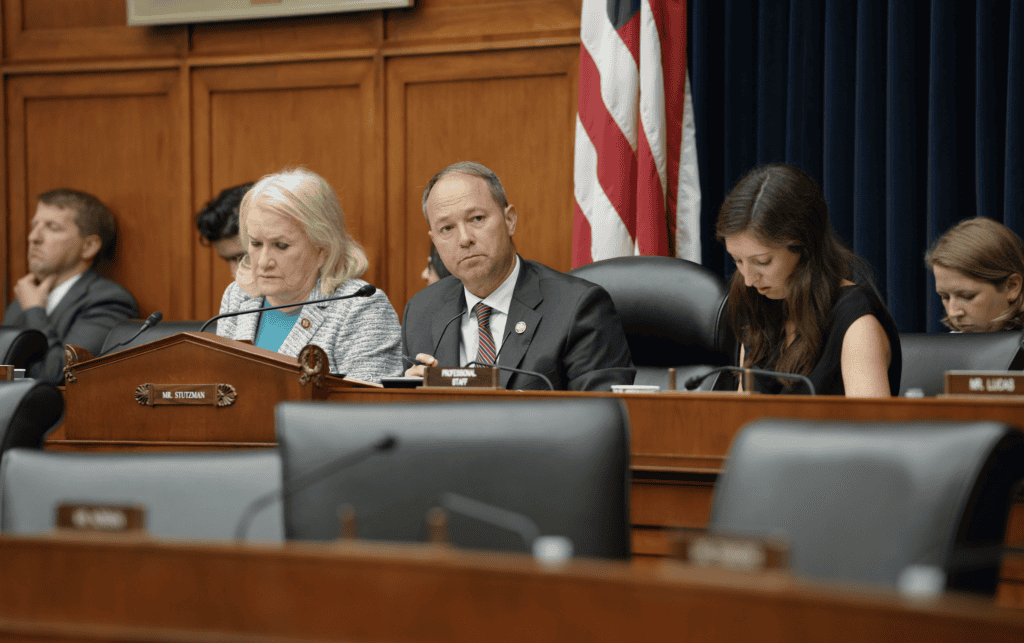
Indiana Rep. Marlin Stutzman (R.) has a vision to lower costs for first-time homebuyers, one that aligns closely with that of President Donald Trump, he told the Washington Reporter in his latest interview.
Stutzman, a member of both the House Financial Services Committee and the House Freedom Caucus, previously unveiled legislation that would prevent institutional investors from buying single-family homes. Then, Trump rolled out a similar vision, giving Stutzman’s proposal a boost.
That restriction, Stutzman said, “gives single family homeowners a chance to buy, and if they can come to an agreement with the seller, that’s great. That’s what you want. But when you have more money coming in from outside investors, you’re going to drive the prices up.”
One of the reasons that Stutzman rolled out the measure was the skyrocketing cost of living under President Joe Biden, and he explained the need to level the playing field in sports terms, as befits a Hoosier.
“It’s like giving one side a ten foot rim and the other side an eight foot rim,” he said. “It’s just an imbalance. And when you have the tallest guys on the team, they’re going to be the ones to win. That’s where I think we have to look out for Americans who really went through a very difficult time during the Biden era. That was not their fault; that was government’s fault. And so that’s why I think government has to be able to step in and help those people get back on track.”
As Stutzman surveys the American economy, he said that “it just seems that lately, the American people have been having to give more, and the takers are not. I’m not saying that’s bad. It’s just that’s the way the economy works. You’ve got supply and demand, and there just has to be a balance, and sometimes the little guy just needs us to step in and say ‘here’s a boost up,’ and we can and help them. Let them go to the front of the line. Give them a chance to pay bills down.”
“Whether you’re an investor, whether you’re somebody just starting and trying to get ahead in life, let’s all look out for each other,” he said. “Right now in a very delicate situation. The people who are making money, they’re making money; it’s the people who are trying to get a start who can’t get ahead. They’re the ones that just keep struggling. Let’s give them a hand up, and let’s do it through the private sector, rather than just handing money out from the government. This is a much better solution in my mind. We have rules for the game, so just because you adjust the rules a little bit, there’s nothing wrong with helping those who are struggling to get ahead a little bit of life.”
In Stutzman’s vision, the restriction on institutional investors would only apply moving forward; a retroactive implementation would get tied up in the courts, he said, adding that he expects litigation regardless should legislation like his move forward. While his measure would restrict the demand-side of home purchases, he said that he doesn’t want the restriction to be permanent. “I think there are some parameters that we could have with that,” he said. “Maybe it’s a 100 day waiting period where the home goes on the market, and after 100 days, if there isn’t a buyer, then institutional investors could then bid. Also, if it’s a rent to own situation, that could also be accommodated for as well.”
Trump’s idea, Stutzman said, stemmed from Trump “listening to the American people and [will] help them accomplish the American Dream.” In recent years, he noted, “the first time homebuyers’ age has gone from 28 to 38 and maybe in some cases, 40. And what that means is that there’s not enough housing. It also means that younger people are having a harder time getting that down payment together to be able to buy that home.”
Another restriction on the demand-side that Stutzman “absolutely” supports is the “slam dunk” idea of preventing Chinese nationals from buying single-family homes. That, he said, is squarely “America First.”
“That’s the sort of thing that President Trump came up with,” Stutzman said. “He’s looking out for Americans first and not the Chinese or not foreign investors, and he wants the American to be better off. I really believe that the gap between the haves and have nots is growing.” He tied that gap to another one of Trump’s proposals: capping credit card interest rates.
“I think that it’s a good idea to cap credit card rates at 10 percent for a year to give people a chance to catch up,” he said. “The cost of life went up so fast under the Biden administration; inflation was just crippling young families and lower to middle income families because they’re trying to pay bills. But then interest rates go up, and the cost of life goes up. And that’s something that I think President Trump is so in tune with.”
“In fact,” Stutzman added, “I told Walmart today that if they would support capping credit cards at 10 percent for one year, let the American people catch up, they’re gonna be more powerful consumers, and then they can start buying more. The alternative is for Americans to make their minimum payment on a credit card, and all they do is pay the interest on it, and they don’t have any buying power, and so they’re never gonna get out of that hole. The thing about banks is that they’re powerful. They’re still going to make money. Let’s help the American consumer catch up a bit, and they’re going to be better consumers. It’s going to benefit both sides, rather than being a one-sided deal.”
One proposal that hasn’t made its way to Stutzman’s desk is from across Capitol Hill, where Sens. Dick Durbin (D., Ill.) and Roger Marshall (R., Kansas) have been working on credit card interest rate caps for years. “I have not looked at it,” Stutzman said. “We’ve been focusing really on President Trump’s proposal.”
Stutzman is not the only Hoosier politician to take housing costs seriously. Rep. Erin Houchin (R., Ind.) previously spoke with the Reporter about her Affordable HOMES Act, which hits close to home for Stutzman, whose father worked in a manufactured housing factory.

Stutzman, who bought his first house when he was 26, said that doing so “really fits the American Dream.”
“We were able to save enough money to go to the bank and get that mortgage, and we felt a sense of fulfillment, and then the utility bills came,” but then came the bills. “Crap. But this is part of life, and it’s an important part of life. It also teaches us to appreciate the dollar better. All of a sudden, you’ve gotta fix the furnace, you’ve gotta do maintenance, and you just learn lessons for life, like more responsibility and taking care of things.”
Below is a transcript of our interview with Rep. Marlin Stutzman, lightly edited for clarity.
Washington Reporter:
Congressman, we just did a piece with Congresswoman Houchin talking about her Affordable HOMES Act, which is for manufactured housing. Is it a coincidence that the Hoosier delegation is at the forefront of these discussions about housing costs and affordability? Is there something in the water there?
Rep. Marlin Stutzman:
My dad actually worked at a manufactured housing plant for a while. You drive up and down the highways and they push you off the roads as they’re coming down with the components for the houses. We have a lot of manufactured housing. It took a big hit after 2008 and the housing crisis, but it’s actually been built back.
Washington Reporter:
If I’m not mistaken, Rudy Yakym’s district has the RV Hall of Fame. Is that right?
Rep. Marlin Stutzman:
That is correct.
Washington Reporter:
Even beyond manufactured housing, why is affordability an important issue for you, especially when it comes to housing?
Rep. Marlin Stutzman:
First of all, it’s part of the American Dream. Every American thinks ‘when can I buy a home for myself?’ Not every American’s gonna do that, but the majority is going to. That’s just part of financial success. You’ve accomplished a point. You could put a down payment on the home, and you start building equity. It’s one of the best assets you could buy for your own personal finances. Owning a home appreciates generally in value, rather than depreciates. So it’s a smart purchase. In Indiana, with the manufactured housing industry there, and of course, construction, this is a clear priority for us. We also have a lot of lumber that’s manufactured in Indiana, a lot of manufacturing for home building, things like that. We’re right in the middle of the country; transportation, distribution is here, so it’s important in every state, but I think for us Hoosiers with the manufactured housing component, we’re the crossroads of America. We’ve even put homes on wheels moving around the country, and it’s a great alternative for families that are looking to buy affordable housing, but it’s good quality, and some of these houses that were built in a factory, and then built out on site, you can’t even tell that they were built in a factory.
Washington Reporter:
Between now and the end of this Congress, what other issues of affordability do you want to focus on? And what do you see Congress prioritizing?
Rep. Marlin Stutzman:
Getting government out of the way. What I mean by that is we had the Streamlined Housing Act inside the 21st Century Housing Act, and it just says that government needs to be on the same page. In this case, HUD and USDA have environmental studies that are required, and sometimes they require different outcomes. When you’re a home builder and you’re working with two different agencies giving you two different answers, it slows you down. And if at some point they’re looking at doing a housing development and they decide that they can’t get some sort of agreement, or they can’t comply, and they would give up on a project like that, which hopefully doesn’t happen often, that is a loss for everyone. Just being slow, and having this slowdown, will cost you money and time, and time is money. The housing industry is such an important piece to the American economy, whether it’s homes or cars, those two are really important to the American family, being productive and secure and safe and also getting to work and keeping the kids in school.
Washington Reporter:
Can you give us a little perspective from your time here, working with the Obama Department of HUD in particular? You just wrote to the Trump HUD and also to the FHFA; how have those approaches have been similar and different from your perspective?
Rep. Marlin Stutzman:
The best example, and Obama is not immune from it, is bigger government. His administration liked bigger government. Look at the two periods of time of when interest rates skyrocketed: Jimmy Carter and Joe Biden; that’s the Democrats’ policy. Bill Clinton actually worked with Republicans on economic policy and it was much better. Having been here during the Obama years, I didn’t think that we could have somebody as bad as Obama, but Joe Biden definitely did. It was just that much worse, and I think it’s because Biden just wasn’t in charge. And I still put some of the blame on the big government era on Obama. So that’s a big difference. Compare that to when Trump comes in; he’s a business guy. He understands what it takes. He knows what it takes to get things done, because he’s a builder. If there’s anybody who knows how to build things well and get things done, it’s President Trump. So that’s probably the biggest difference. It’s exciting to be here while President Trump is here and moving and he moves quickly.
Washington Reporter:
Are there other things that you want to see from the rest of his administration? Houchin’s bill targeted Energy Department regulations; you recently wrote to HUD and to FHFA. Are there more things that you want to see from his cabinet on this issue to work in concert with you?
Rep. Marlin Stutzman:
He recently made the proposal about banning institutional investors from buying single-family homes. We actually had already had a bill to keep institutional investors out of single family homes. I think it’s a great idea, because we know that the first time homebuyers’ age has gone from 28 to 38 and maybe in some cases, 40. And what that means is that there’s not enough housing. It also means that younger people are having a harder time getting that down payment together to be able to buy that home. President Trump says ‘look, let’s keep institutional investors on the sidelines so that way single families can buy a home.’ That’s listening to the American people and trying to help them accomplish the American Dream. It’s a really important conversation about having a policy that we should implement for a period of time. I think there are some parameters that we could have with that. Maybe it’s a 100 day waiting period where the home goes on the market, and after 100 days, if there isn’t a buyer, then institutional investors could then bid. Also, if it’s a rent to own situation, that could also be accommodated for as well. There are different ideas, but President Trump’s instincts are so good in knowing what the American people are needing and asking for, and he’s proposing to Congress several ideas when it comes to affordability and the cost of living. Look at interest rates, that’s a big factor, and he keeps beating up on Jerome Powell to lower interest rates, because he knows that that will help the American consumer.
Washington Reporter:
Congress has spent time looking at Chinese ownership of farmland near military bases. Do you think that restricting foreign, especially adversarial foreign ownership, is something also that would make sense for Congress to consider in terms of looking at the supply of housing?
Rep. Marlin Stutzman:
Yes, absolutely. America first. That’s the sort of thing that President Trump came up with; he’s looking out for Americans first and not the Chinese or not foreign investors, and he wants the American to be better off. I really believe that the gap between the haves and have nots is growing, and just like the credit card caps; I think that it’s a good idea to cap credit card rates at 10 percent for a year to give people a chance to catch up. The cost of life went up so fast under the Biden administration; inflation was just crippling young families and lower to middle income families because they’re trying to pay bills. But then interest rates go up, and the cost of life goes up. And that’s something that I think President Trump is so in tune with. He’s saying, ‘look, we don’t want these people in here for a variety of reasons. It’s not just for economic issues, but it’s also national security issues.’ That’s a slam dunk.
Washington Reporter:
Is the Durbin-Marshall credit card legislation on the Senate side something that you’re tracking?
Rep. Marlin Stutzman:
I have not looked at it. We’ve been focusing really on President Trump’s proposal, maybe that’s what that is.
Washington Reporter:
It depends on the iteration of the proposal. But shifting back to housing, I want to drill down on how you came to this position; I think of you as being in a tug of war between the Financial Services Committee and the Freedom Caucus on the issue of banning institutional investors from buying single family homes. How did you come to that? Was this something that you already been kicking around in your mind?
Rep. Marlin Stutzman:
Usually in any transaction, you have givers and takers or vice versa, and it just seems that lately, the American people have been having to give more, and the takers are not. I’m not saying that’s bad. It’s just that’s the way the economy works. You’ve got supply and demand, and there just has to be a balance, and sometimes the little guy just needs us to step in and say ‘here’s a boost up,’ and we can and help them. Let them go to the front of the line. Give them a chance to pay bills down. In fact, I told Walmart today that if they would support capping credit cards at 10 percent for one year, let the American people catch up, they’re gonna be more powerful consumers, and then they can start buying more. The alternative is for Americans to make their minimum payment on a credit card, and all they do is pay the interest on it, and they don’t have any buying power, and so they’re never gonna get out of that hole. The thing about banks is that they’re powerful. They’re still going to make money. Let’s help the American consumer catch up a bit, and they’re going to be better consumers. It’s going to benefit both sides, rather than being a one-sided deal.
Washington Reporter:
I want to get to what this policy would look like if it’s enacted. If this restriction takes effect tomorrow, in your version vision of it, would it apply retroactively? If the institutional investors had already owned the single family home, would they have to divest? Or is this just a forward-looking change?
Rep. Marlin Stutzman:
Forward-looking. It needs to be that, because you would otherwise have some court challenges for sure. There will probably be court challenges anyway. Whether you’re an investor, whether you’re somebody just starting and trying to get ahead in life, let’s all look out for each other. Right now in a very delicate situation. The people who are making money, they’re making money; it’s the people who are trying to get a start who can’t get ahead. They’re the ones that just keep struggling. Let’s give them a hand up, and let’s do it through the private sector, rather than just handing money out from the government. This is a much better solution in my mind. We have rules for the game, so just because you adjust the rules a little bit, there’s nothing wrong with helping those who are struggling to get ahead a little bit of life.
Washington Reporter:
I want to make sure I put in your words in your mouth and don’t mischaracterize what you’re saying. How would this policy lower costs for home buyers in your view?
Rep. Marlin Stutzman:
Well, for one, it gives single family homeowners a chance to buy, and if they can come to an agreement with the seller, that’s great. That’s what you want. But when you have more money coming in from outside investors, you’re going to drive the prices up. And most people say that’s what the free market does, but you know what? Look at the game of basketball. It’s like giving one side a ten foot rim and the other side an eight foot rim. It’s just an imbalance. And when you have the tallest guys on the team, they’re going to be the ones to win. That’s where I think we have to look out for Americans who really went through a very difficult time during the Biden era. That was not their fault; that was government’s fault. And so that’s why I think government has to be able to step in and help those people get back on track.
Washington Reporter:
What was the story of your first home purchase, and what lessons do you wish that you knew back then based on your time in the private sector and public policy and working on these issues?
Rep. Marlin Stutzman:
I was 26 when Christy and I bought our first home. It was a two story home, it had a nice yard, a front yard and a back yard. That’s where our first son was born. It really fits the American Dream. We were able to save enough money to go to the bank and get that mortgage, and we felt a sense of fulfillment, and then the utility bills came. Crap. But this is part of life, and it’s an important part of life. It also teaches us to appreciate the dollar better. All of a sudden, you’ve gotta fix the furnace, you’ve gotta do maintenance, and you just learn lessons for life, like more responsibility and taking care of things.
Washington Reporter:
We’re hitting America 250 this year, and you’re talking about the American Dream. How do you see that concept changing or staying the same for the next 250 years?
Rep. Marlin Stutzman:
We’re such a transient world now. You can travel, you can communicate. But I think there’s still something to be said that people like to have their own space, their own place. And it’s not for everybody. Having an apartment for me in D.C. makes a lot of sense, rather than buying something here, because I’m not here all the time, but having my home in Indiana and having my farm there, that’s my place. And I get to go home and and be with my family and celebrate the successes of life and but there are always going to be challenges that we have to deal with. It’s really that place of belonging that we often have. Whenever you sell a house, there’s a part of you that is sad because there are a lot of memories. Whenever I drive past our first home, I feel that. I even drive past the home where I grew up from when I was 12, and I always think about the memories there. My oldest son is 24, and we have two homes in Indiana, and I tell him that he doesn’t need to worry about housing, but he say ‘no, I want to do this.’ He sees that there is fulfillment in getting a home of his own. He wants that sense of ownership.
Washington Reporter:
Well, having a Republican dad surely helps with that feeling for your son. Congressman, thanks as always for chatting.