Prediction markets are a hot topic in Washington, D.C.; members of Congress have introduced more than half-a-dozen bills on prediction markets in the past month and one company, Polymarket, even opened a bar in Washington, D.C., called the “Situation Room,” which features live sports, politics, and prediction market feeds.
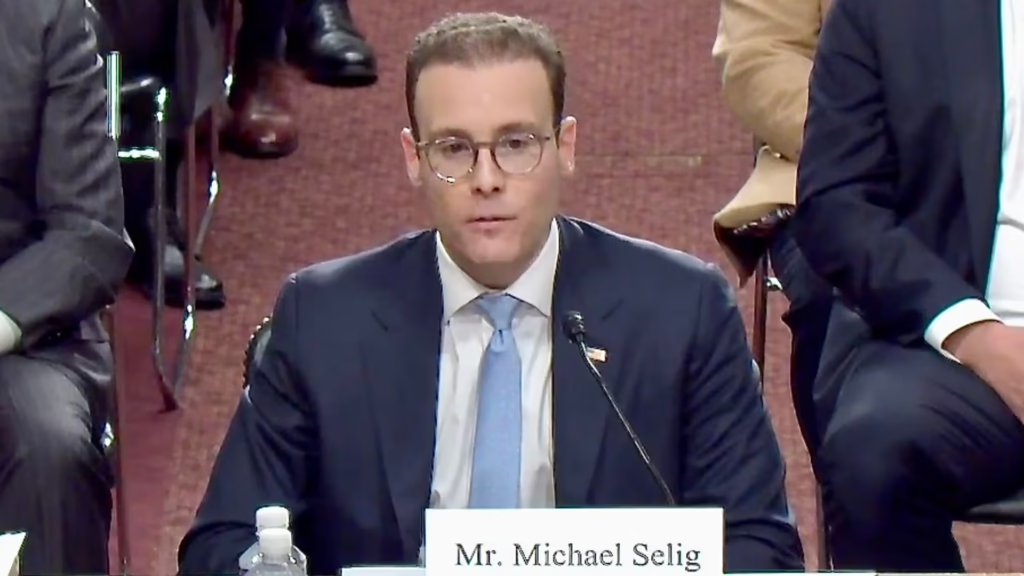
The Washington Reporter interviewed Commodities Future Trading Commission (CFTC) Chairman Mike Selig, whose agency is tasked with regulating prediction market exchanges.
“Prediction markets are one of the most exciting financial products in our regulatory purview right now,” Selig told the Reporter.
Prediction markets, or “event contracts” as the CFTC calls them, are derivatives contracts that pay out based on an event outcome that has economic implications, such as a political election or sporting event, he explained. Users can use prediction markets, like Polymarket and Kalshi, to trade on everything from to how many times Elon Musk might tweet in a week to whether the Federal Reserve will raise or lower interest rates to how much snow would fall in New York City during the city’s most recent snowstorm.
These contracts, along with contracts on sports outcomes like which team will win the Super Bowl, are in the CFTC’s jurisdiction, trade on CFTC-regulated exchanges, and are subject to the federal derivatives regulatory framework established by Congress over several decades and pieces of legislation.
As these markets grow quickly, Selig and his agency are taking steps to ensure the markets are well-surveilled and have appropriate safeguards and protections in place.
“There’s this false media narrative that CFTC-regulated markets are the Wild West and have no regulation and that’s blatantly false,” Selig said. “The CFTC uses complex surveillance tools and has seasoned career staff that pro-actively monitor these markets for insider trading and fraud.”
The agency, which was seen as relatively sleepy in the past, has exploded into Washington’s political scene given the rise in prediction markets. Prediction markets, the first of which was established in the early 1990s, have seen significant growth since 2023, when traders correctly predicted against public polls that President Donald Trump would beat then-Vice President Kamala Harris.
Sports have also become a flash point in prediction markets over accusations of insider trading and degradation of sports integrity. Selig told the Reporter he’s taken swift action on the sports front to protect the integrity of the game. The CFTC recently announced a joint partnership with the Major League Baseball (MLB) to help combat fraud and protect players and fans. The agreement focuses on data sharing, open lines of communication, and discussion around emerging trends.
Selig, a longtime Philadelphia Eagles fan who has a signed Jalen Hurts football in his D.C. office, sounded optimistic that the agency would sign similar agreements with other professional sports leagues.
The CFTC also recently released staff guidance to provide clarity on contracts that it sees as more subject to manipulation and rolled out an Advanced Notice or Proposed Rulemaking (ANPRM) asking for public comment as the agency prepares to formalize regulations around prediction markets.
“We’re looking forward to engaging with our exchanges, market participants, lawmakers, and tribal leaders to make sure we get this right,” Selig said. “We don’t want to see these markets pushed offshore — they need to be regulated right here.”
Selig noted that there is much more to come, and the CFTC’s recent moves are just the beginning of its work to protect markets and their participants. The Reporter will closely cover these developments as they unfold.