The strike is politically risky — but there’s also opportunity here for the GOP if executed (and messaged) correctly.
President Donald Trump ran on ending American foreign “adventurism” and ushering in a new era of world peace. Now, he’s pulled the country into a regime-change war in Iran.
With the midterms around the corner — and most Americans wary of U.S. entanglement in another Middle East conflict — “Operation Epic Fury” is probably the riskiest move Trump has made since retaking office.
Sure, he’s bragging that Ayatollah Khomeini is dead — along with dozens of top Islamic Republic leaders. But as of Sunday morning, so, too, are at least three U.S. soldiers. And this is only the beginning.
Questions are swirling: How long will this campaign last? Will the president order boots on the ground? What does the endgame look like?
Still, despite the risks, the reward could be huge if Trump pulls this off. It’s a big “if” — but if this president manages to end nearly 50 years of Islamic Republic brutality and lead Iran to a new dawn — all without pulling the U.S. into an extended, months-long engagement — even Democrats would be hard-pressed to deny it’s a new chapter worth celebrating.
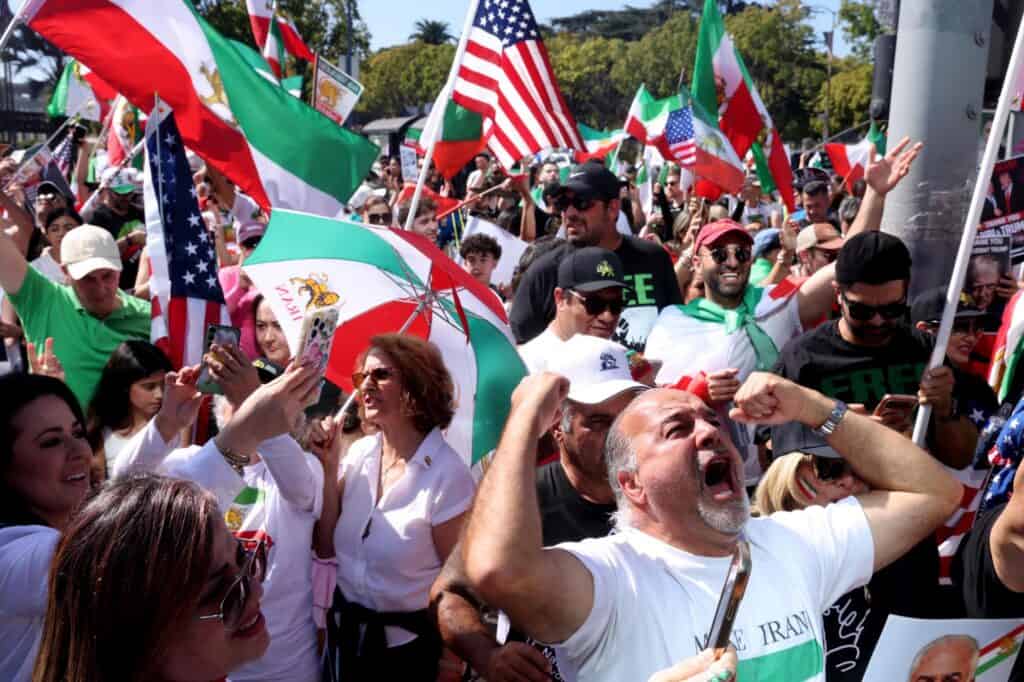
“This will be like ending the Soviet Union, the Berlin Wall. This is a transformational moment for humankind, for security,” Iranian-American Moj Mahdara told CNN’s Dana Bash on Sunday morning. Mahdara, a Democrat, even went on to lecture her own party, arguing that, “it is imperative the Democrat Party wake up and get past their dislike of President Trump,” while recognizing the importance of the moment.
Recent polling encapsulates the political dangers — but also the opportunity for the GOP. In a study conducted days ago, with talks of a strike looming, only 21 percent of voters backed the U.S. bombing Iran. A majority of Republicans even opposed such actions, with only 40 percent in favor.
But the same study shows large chunks of voters — 30 percent overall — aren’t sure what to think. That’s a chance for the party to shape the narrative and possibly even flip the script, as difficult as that may be.
We saw similar undecided numbers when the president snatched Nicolás Maduro from Venezuela — even as legacy media breathlessly fixated on the public’s overall opposition to the operation. And sure enough, after the administration kept the campaign narrow and limited — with no U.S. boots on the ground and no American deaths — approval increased over time, particularly among Republicans.
The situation in Iran is much more complex, of course. Unlike with Venezuela, we’re talking regime change here — even as Americans are tired of playing world police. There’s real anxiety about what follows. A power vacuum that serves as a breeding ground for terrorism. Chaos. Perhaps even a more radical leader.
That’s to say nothing about the tragic loss of American life, a game-changer on its own that hits home for many voters. Suddenly, the sacrifice of our nation has a face and a name. And many will question whether going to war with Iran — however brief — was worth it.
The challenge for Republicans is that the party hasn’t made the case for war to the public, even as they may think the rationale is obvious. Even many Republicans admit privately that the White House has fallen down on messaging the need for action, the endgame and strategy. Some have told me they wish Trump would have spent more time on Iran during his State of the Union, when more than 30 million Americans turned in.
Democrats, meanwhile, are hammering home what they decry as Trump’s broken campaign promise to end war. Amplified by MAGA voices like Tucker Carlson, who feel betrayed and are calling the operation “absolutely disgusting and evil,” they’re accusing the president of a mess of his own making.
“Barack Obama reached a deal that prevented Iran from getting a nuclear weapon. Trump ripped up that deal. Now we are at war with Iran to prevent it from getting a nuclear weapon,” wrote longtime Dem strategist Dan Pfeiffer on X. (The missive had five million engagements.)
There are also complications with the message itself. Back in June, when the U.S. first struck Iran, the administration claimed the weapons program was obliterated and attacked reporters citing an internal assessment suggesting it was not. Now they argue the nuclear threat was enough to act, a circle Republicans will have to square in TV hits this week.
To be fair, however, Democrats aren’t united either — a sign that they’re also unsure how the political chips will fall. Sen. Jon Ossoff — the lone Senate Democrat facing re-election in a Trump state — has blasted Trump for attacking, suggesting even vulnerable Dems think Iran politics are ugly for the president.
But others who know foreign policy well, like Sen. Chris Coons (D-Dele.) — no Trump-lover himself — have been more nuanced.
“The Iranian regime has been the greatest exporter of terror in the region, and I will not grieve for one moment the passing of the supreme leader of Iran,” Coons said on the same CNN program this morning, even as he has argued that “this is not how a democracy goes to war.”
What probably won’t work with the public? Democrats complaining about process, whining that Congress’ congressional authority has been discarded. But if more Americans die — and this engagement drags well into 2026 — expect more voters to side with the left and the Tucker Carlsons of the world.