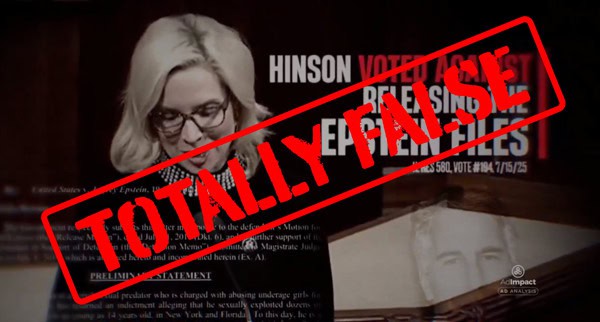
A super PAC aligned with Senate Democrats is running an ad on the Iowa airwaves claiming that Rep. Ashley Hinson (R., Iowa) “took nearly $90,000 from people in the Epstein files and voted to keep those files secret.”

What the Ad Says

Amber Gustafson, a former Democratic candidate for the Iowa Senate, says in WinSenate’s ad that she “[doesn’t] trust” Hinson because of the Republican’s votes against releasing the Epstein files.

The Claim

“Hinson voted against releasing the Epstein files”; Hinson, the failed Democrat added, “voted to keep those files secret.”

The Evidence

WinSenate’s ad cites a July 2025 vote by Hinson in which she voted for what Hinson’s campaign calls “a routine procedural vote on ‘ordering the previous question,’” referring to Roll Call 194.

Hinson Campaign’s Response

Hinson’s campaign said “Ashley Hinson voted to release the Epstein files,” her campaign’s communications director, Billy Fuerst, told the Washington Reporter. “This was the only actual vote on the Epstein Files Transparency Act and Ashley voted yes.”

Fuerst responded directly to the Democrats’ allegations, saying that “WinSenate instead cites Roll Call 194, a routine procedural vote on ‘ordering the previous question.’ Democrats said that if the previous question were defeated, they would seek to amend the rule to force a vote on the Epstein files. But that hypothetical amendment was not what members were voting on — they were voting on a procedural motion to advance several bills, including a defense appropriations bill that raised troop pay by 3.8 percent.”

“A vote to order the previous question cannot accurately be characterized as a vote against hypothetical legislation,” Fuerst continued. “There was only one vote to release the Epstein files on the House Floor, and Ashley voted yes.”

Washington Reporter’s Assessment

The ad makes two factual claims. Both are false. Here’s our analysis of each one.

Claim 1 False

“Rep. Hinson voted against releasing the Epstein files.”

Our Analysis

The first claim is completely false. In fact, it’s so false it is a surprise this ad was made in the first place, and that it’s been allowed on the airwaves. The House of Representatives voted one time on whether to release the Epstein files on November 18, 2025; the bipartisan Epstein Files Transparency Act sailed through both the House and the Senate. Hinson voted yes. The link to her vote is here, from the Clerk of the House.

The WinSenate ad refers to a different, procedural vote that was not a vote on whether to release the Epstein files. Because Hinson unequivocally voted in favor of releasing the Epstein files, no fair observer could say she voted against releasing the files.

Claim 2 False

“Rep. Hinson took $90,000 from donors who are ‘in’ the Epstein files.”

Our Analysis

The claim that Hinson received $90,000 from donors “in” the Epstein files is misleading to the point of being dishonest. The implication is clearly that Hinson is receiving donations from individuals who worked with Epstein to harm women.

However, the Epstein files include 3.5 million pages. These pages include countless news articles sent by or to Jeffrey Epstein. Being mentioned “in” the Epstein files is meaningless, unless there is additional evidence that the individual also committed some bad act or assisted Epstein in his crimes.

For example: Martin Luther King Jr. is mentioned in various news articles found in the Epstein files. So are Jesus Christ, Barack Obama, and Chuck Schumer, but, of course, merely being mentioned in a 3.5 million page document does not suggest wrongdoing. By this ad’s standard, these individuals are “in” the Epstein files.

This ad provides no evidence that Hinson’s donors who were supposedly mentioned “in” the Epstein files committed any type of bad conduct. The Reporter attempted to reach out to WinSenate for its comment defending its ad, but the Democratic super PAC has no contact information available. Hinson’s campaign also points out that multiple donors to her opponent are mentioned in the Epstein files, further showing that this claim is nonsense.

Our Conclusion

We score each ad on a scale from 1 to 5. A 1 is completely false, and a 5 is completely true. Most ads are in the middle.

In this case, because both of the factual claims are false and misleading to such a degree as to be dishonest, this ad scores as a 1: completely false.

Our Rating
1 / 5
Completely False

1 2 3 4 5
False  ·  True