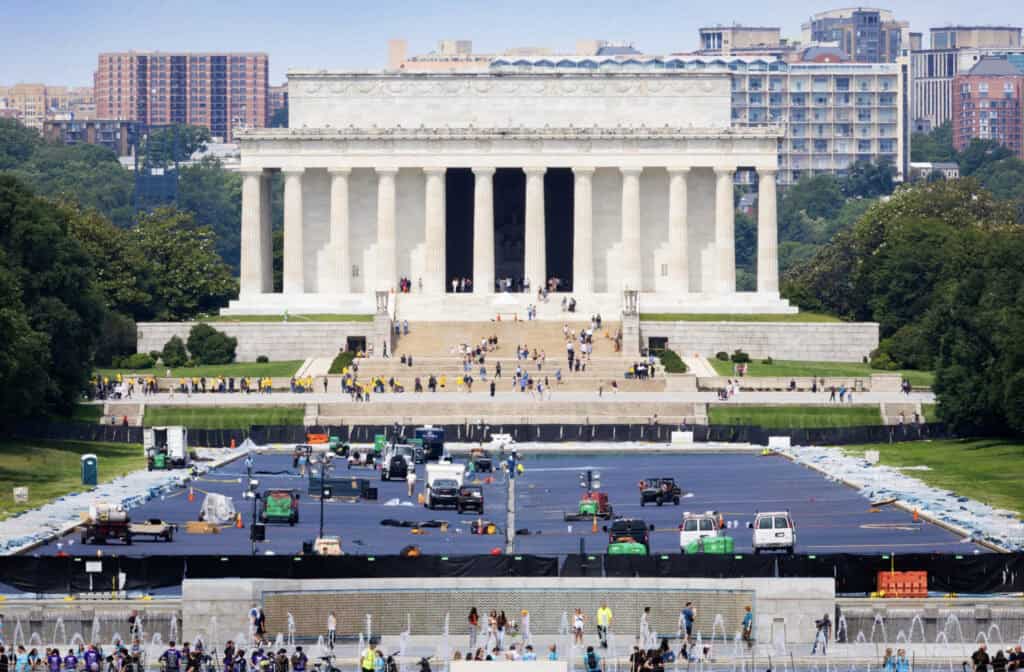
President Donald Trump are Interior Secretary Doug Burgum are getting backup on their move to restore the Lincoln Memorial’s Reflecting Pool ahead of America’s 250th birthday from Rep. Lance Gooden (R., Texas).
Gooden submitted an amicus brief, obtained exclusively by the Washington Reporter, supporting Trump’s long-awaited renovation of the Reflecting Pool — which he is doing as he and Burgum renovate their ways across Washington, D.C.
But, a lawsuit, The Cultural Landscape Foundation v. U.S. Department of the Interior, has been trying to slow roll the moves. The suit seeks to block the administration’s moves to modernize the pool, which begun in mid-April.
“Only in Washington would activists sue to stop the restoration of one of America’s most iconic landmarks,” Gooden told the Reporter. “President Trump is working to restore beauty and pride to our nation’s capital, while his opponents would rather leave the Reflecting Pool deteriorating just to score political points against him.”
While Gooden’s interest in the case may seem unusual at first, he notes in the brief that he has an immediate interest given his role in Congress. “Representative Gooden serves on the House Committee on the Judiciary and its Subcommittee on the Administrative State, Regulatory Reform, and Antitrust,” his briefing notes. “In that capacity, Representative Gooden has a direct institutional interest in the proper scope of judicial review of executive-branch maintenance and management decisions under the Administrative Procedure Act and similar statutes. Representative Gooden likewise has an institutional interest in preserving the extraordinary nature of preliminary injunctive relief, including the requirement for irreparable harm, so that the judiciary does not micromanage the Executive Branch’s day-to-day stewardship of federal property.”
In his amicus brief, Gooden also argued that the Cultural Landscape Foundation lacks legal ground to push for an emergency halt of the project.
Gooden wrote in the brief that “[the] Plaintiffs have not demonstrated the imminent, irreparable harm that equitable principles demand before a court grants extraordinary preliminary injunctive relief.” He also noted that the disagreement over the shade of the sealant at the base of the pool “does not rise to the level of severity contemplated by the D.C. Circuit’s irreparable harm standard.”
“There are undoubtedly circumstances in which aesthetic harms would satisfy the demanding test for preliminary injunctive relief,” Gooden acknowledged. “But this case does not involve the sort of serious, concrete, and imminent harms necessary to fall within that category. For that reason and the others given above, the Court should deny Plaintiffs’ motion for a temporary restraining order and preliminary injunction.”