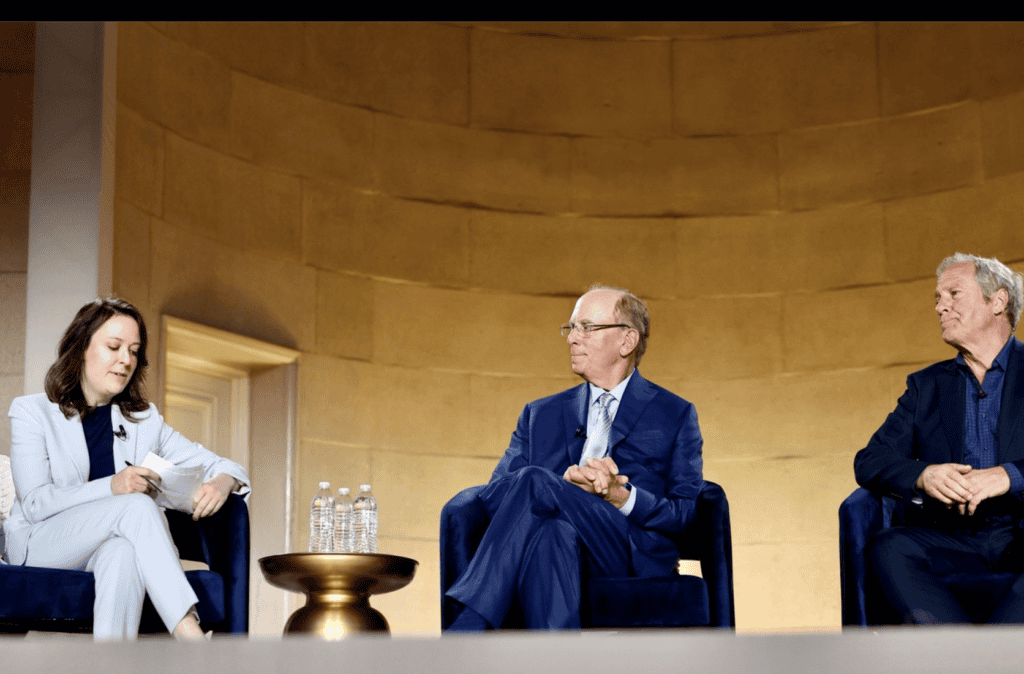
BlackRock’s Infrastructure Summit brought together Cabinet secretaries, Republican and Democratic Senators, and industry heavyweights Wednesday to ask a pointed question: does America still know how to build things?
The answer from the room was “yes” — but not without a serious course correction on energy, permitting, and workforce training.
Energy Secretary Chris Wright called for flexible permitting frameworks and pro-growth energy policies. “One of my missions coming to Washington is to make it easier to build big things again in our country,” Wright said, noting the U.S. had done “precious little of that in the last 20 or 30 years.” The reindustrialization agenda, Wright argued, starts with rethinking energy supply and demand — and data centers are the path to lower electricity prices, higher wages, and expanded tax revenues, not a drain on the grid.
Interior Secretary Doug Burgum was more blunt. He said the prior administration sold Americans a failed “energy subtraction” scheme dressed up as a transition. The proof was Winter Storm Fern, when wind and solar generated just 2 percent of output at peak demand while coal and nuclear kept the lights on — and burning wood and trash outperformed both renewables combined.
Sens. Steve Daines (R., Mont.) and Catherine Cortez Masto (D., Nev.) found rare common ground on the scale of the problem. “We are going to need 50-80 percent more energy in the next five years,” Daines warned. Sen. Dave McCormick (R., Pa.) widened the lens, arguing that the technicians, electricians, and truck drivers undergirding the AI economy represent a workforce crisis hiding in plain sight — one that demands a fundamentally different approach to training Americans for the jobs that actually exist.
That’s where Mike Rowe came in. The “Dirty Jobs” host told the audience that the stigma surrounding blue-collar work is real and was deliberately cultivated — generations of students have been steered away from the trades by a college-or-bust establishment that never respected the work. “We need to make a more persuasive case for the opportunities that currently exist,” Rowe said. Rep. Riley Moore (R., W.V.) — a former welder who has made skilled trades his signature legislative priority and joined Rowe’s podcast to make the case for investing in the trades — used the moment to amplify his Jumpstart Savings Act, noting that starting a business in the trades can cost more than $100,000 and that his bill creates a tax-free way to save for the tools, licensing, and startup costs needed to build a career. Moore drew the legislation from his own experience as a welder and from a program he successfully launched as West Virginia’s State Treasurer, arguing that it’s time to bring the idea to the federal level to help “Jumpstart America’s new Golden Age.”
BlackRock’s Larry Fink backed up the talk with $100 million in philanthropic funding — the “Future Builders” initiative — to connect 50,000 Americans with urgent vacancies for electricians, HVAC technicians, plumbers, and ironworkers over the next five years. Fink noted America needs an estimated $10 trillion in infrastructure investment by 2033. “Capital alone is not enough,” he said; people are the variable that determines whether that investment pays off.
With China racing to build AI infrastructure at scale and America’s grid straining to keep up, the Summit’s consensus was clear: the United States has the capital, the policy tools, and the political will. What it needs now is the workforce — and the cultural shift to build one.