BOCA RATON, Fla. —
While Keith Sonderling, the Acting Labor Secretary, did not attend Florida Atlantic University (FAU) for college or for law school, he is now an expert at what both its nationally-recognized laboratory school and its College of Engineering and Computer Science offer, following an extensive visit to both campuses, where he saw firsthand about how American schools are innovating in real time to train students for the jobs of the future.
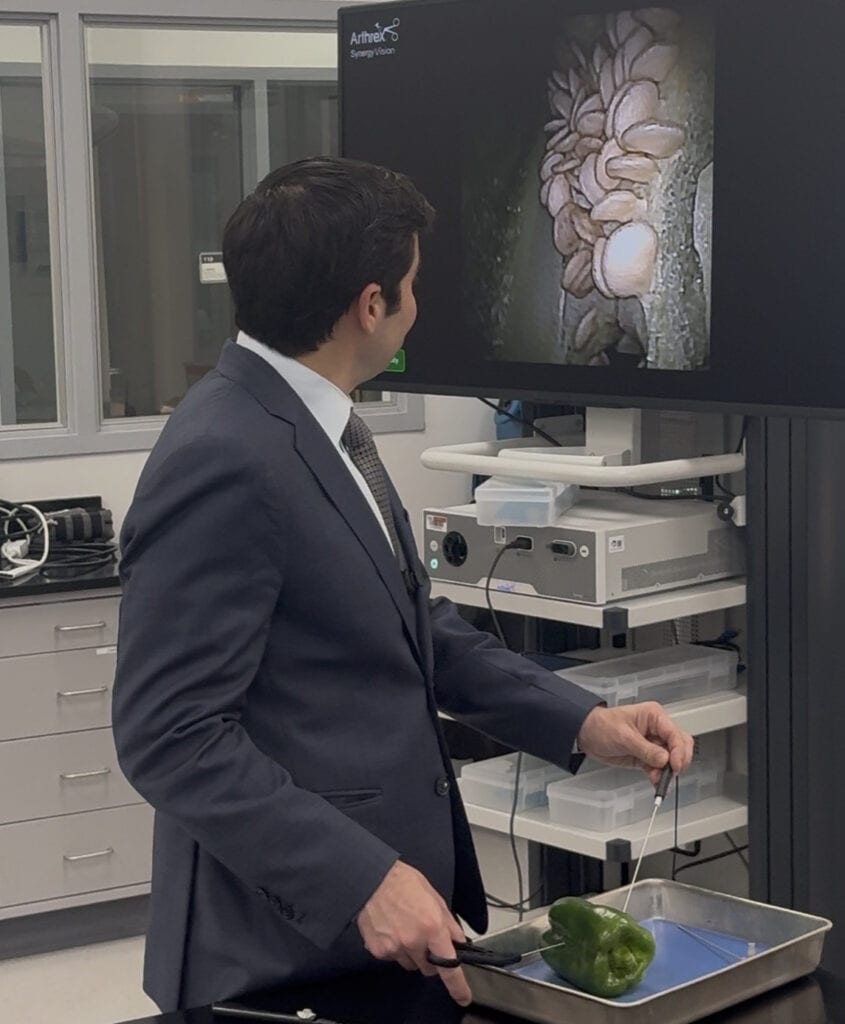
Sonderling started the day off at the Alexander D. Henderson University School, which is a public elementary and middle school on FAU’s campus. While touring the new campus, he participated first-hand in surgeries that students were working on with sheep brains and with a green bell pepper — although in the estimation of those present, he would be better off sticking with his day job.
“In the Trump administration, we’re really trying to reinvent not only workforce development but also education in our partnership with the Department of Commerce and with the Department of Education,” Sonderling told the Washington Reporter in an interview. “We’re working on America’s talent strategy plan for the Golden Age of the American workforce. We’re really seeing it here live in action at FAU; a big part of what we’re trying to change is moving away from academia just dictating what curriculum should be, and working with employers, and employers in local communities, and having them tell us what that industry-led curriculum need, telling us what equipment they’re using, telling us what investments they’re making in those local communities, so we can get those new American jobs that the president is bringing back to the local workforce, especially for students who are coming out of school now and who really want these high-skilled, high-paying jobs.”
At Henderson, those practical skills lessons were on full display. During Sonderling’s tour, he saw students doing mock dissections of humans, as well as where they do archaeological digs, analyze critical miners, 3-D print bones, build drones, use high-tech microscopes to investigate contamination of local water supplies, and analyze critical minerals.
The latter, Sonderling noted, is of particular interest to the Trump administration. “It’s so important that the Trump administration is working not only with universities but also with the pre-K-12 system,” he told the Reporter. “As we’ve seen, we can’t rely on foreign adversaries for critical minerals for the supply chain, and the president has been committed to bringing those back to America. We’re seeing that with the historic investments in industries that have left automotive manufacturing, pharmaceutical manufacturing, defense manufacturing; they’re all coming back to the U.S. The most important thing that we can do at the Department of Labor is to work with our partners in education, to work with our partners in industry to make sure that Americans get those jobs, but more importantly, that Americans have training.”
At Henderson, students are able to analyze the minerals themselves first-hand. “What we’re seeing here is a model of what I’d like to see across the country, where local businesses come together, work with universities, work with high schools, and give them the equipment that they’re going to use when they get those jobs, and really dictate what that curriculum is, because that curriculum is what is going to allow them to be successful and have long-term high-paying careers in their local communities, and that’s what the president wants,” Sonderling said.
One teacher told Sonderling that other lessons at Henderson include “how to use a CT-Scan with kindergartners.” Sonderling described the partnership that FAU and Henderson have as a model that should be replicated across the nation; students who attend Henderson are dual-enrolled in classes at FAU, which allows them to make significant strides towards earning a bachelor’s degree debt-free while still in high school.
“The most important thing for us is we need to deliver the education and the curriculum for them, and there’s no better way to do it than working with industry and having industry invest in local partners and local pre-K-12 and local community colleges and local colleges to work together to make that curriculum, so that when they enter the workforce they’re ready for those high-skilled, high-paying jobs with no training needed, and we’re really seeing that here at FAU,” he said.
One of the projects, a Henderson teacher explained, is a study of “the organization of the shark brain and the smelling centers, because we don’t really know how it’s organized.” Students there use a joystick while modeling the shark brain, because Henderson’s staff want the process to be “friendlier to younger students” while still being practically useful.
As Sonderling was concluding his Henderson visit, one of the school’s trustees wanted to explain to him exactly why the school’s model is so important. “About a third of the kids at the K-8 are Title I, and it’s a lottery, so it’s completely random,” the trustee explained. “[Dr. Joel Herbst — the Superintendent of Schools for the FAU pre-K-12 Laboratory School District] has proven that all kids are smart. Given the right opportunity and the right skills and the right level of teaching, everybody is going to excel in this world. Saying that public education fails the kids [is an incomplete analysis]. They are failing the kids, because they are smart. And he’s proven it.”
While Sonderling has been described by journalists like Newsmax’s Ed Henry as the “pride and joy of Boca Raton,” he did not attend a high school like Henderson. “I did not have this kind of experience,” he said, reflecting on the school’s futuristic educational models. “In fact, I don’t think any of us had this kind of experience in high school, and now you see kindergartners using these high-tech equipments, the same equipments they will be using when they get these high-paying jobs. If I had that opportunity when I was in elementary and middle school, who knows if I would be in this role right now.”
Following his visit to Henderson, Sonderling went down the street to FAU’s College of Engineering and Computer Science and to D-Wave, which is the world’s first commercial supplier of quantum computers.
While at FAU, Sonderling noted that under Trump, “we’re seeing trillions of dollars in investments from foreign countries, from foreign companies, and domestic companies saying we believe in what this administration wants to do: we want manufacturing back in America, and we want Americans to get those jobs.”
From his standpoint at the Department of Labor, he wants to help companies like Ford push for apprenticeship programs. “What we’re really trying to push at the Department of Labor is apprenticeships, working with these companies that are bringing these jobs back, having an earn while you learn model, and the companies are committing to train the employees and pay them; they are really working with local community colleges, with local academic universities, and with high schools to integrate that curriculum and that training, all while providing a debt-free way for students to get immediately in the workforce and not have to sit in college for four to six years and get that debt,” he explained. “Instead, they can start working right out of high school if they want in high-paying jobs, and we’re really excited about that. Under this administration, we’ve already had over 400,000 new registered apprenticeships with over 3,300 new programs, and what’s so special about this is that the average starting salary for these jobs is $86,000 with zero debt. That’s what we’re trying to work on, but it takes buy-in not only from the employers but from the academic institutions as well.”
The Reporter interviewed Sonderling in front of an 18-screen backdrop where FAU students are able to monitor weather trends, for example, in real time — a major concern for Floridians given the state’s history with hurricanes and other extreme weather events.
When asked by the Reporter what situations he would monitor if he had a similar setup at home, he replied: “I would be monitoring your Twitter feed.”
Below is a transcript of our interview with Acting Labor Secretary Keith Sonderling, lightly edited for clarity.
Washington Reporter:
Right now, we are at this sprawling campus for FAU, and you were just talking at the K-12 campus about the private sector’s role in pre-K-12 education; while on that campus, you looked at critical minerals research, you looked at drones, you looked at health care. What were your impressions from what you learned so far today?
Acting Labor Secretary Keith Sonderling:
In the Trump administration, we’re really trying to reinvent not only workforce development but also education in our partnership with the Department of Commerce and with the Department of Education. We’re working on America’s talent strategy plan for the Golden Age of the American workforce. We’re really seeing it here live in action at FAU; a big part of what we’re trying to change is moving away from academia just dictating what curriculum should be, and working with employers, and employers in local communities, and having them tell us what that industry-led curriculum need, telling us what equipment they’re using, telling us what investments they’re making in those local communities, so we can get those new American jobs that the president is bringing back to the local workforce, especially for students who are coming out of school now and who really want these high-skilled, high-paying jobs. The most important thing for us is we need to deliver the education and the curriculum for them, and there’s no better way to do it than working with industry and having industry invest in local partners and local pre-K-12 and local community colleges and local colleges to work together to make that curriculum, so that when they enter the workforce they’re ready for those high-skilled, high-paying jobs with no training needed, and we’re really seeing that here at FAU.
Washington Reporter:
As you’ve been traveling the country, how have you seen K-12 schools work on things like national security, like that critical minerals lab that they had there to combat adversaries like China, and to help with American supply chains?
Acting Labor Secretary Keith Sonderling:
That’s why it’s so important that the Trump administration is working not only with universities but also with the pre-K-12 system. As we’ve seen, we can’t rely on foreign adversaries for critical minerals for the supply chain, and the president has been committed to bringing those back to America. We’re seeing that with the historic investments in industries that have left automotive manufacturing, pharmaceutical manufacturing, defense manufacturing; they’re all coming back to the U.S. The most important thing that we can do at the Department of Labor is to work with our partners in education, to work with our partners in industry to make sure that Americans get those jobs, but more importantly, that Americans have training. What we’re seeing here is a model of what I’d like to see across the country, where local businesses come together, work with universities, work with high schools, and give them the equipment that they’re going to use when they get those jobs, and really dictate what that curriculum is, because that curriculum is what is going to allow them to be successful and have long-term high-paying careers in their local communities, and that’s what the president wants.
Washington Reporter:
You were mentioning auto manufacturers just now. We know Ford, for example, has worked with the Department of Labor in the past. How do you, in your new role, want to work with national and international companies on apprenticeships or other projects in this Golden Age of Trump’s second term?
Acting Labor Secretary Keith Sonderling:
We’re seeing trillions of dollars in investments from foreign countries, from foreign companies, and domestic companies saying we believe in what this administration wants to do: we want manufacturing back in America, and we want Americans to get those jobs, so what we’re really trying to push at the Department of Labor is apprenticeships, working with these companies that are bringing these jobs back, having an earn while you learn model, and the companies are committing to train the employees and pay them; they are really working with local community colleges, with local academic universities, and with high schools to integrate that curriculum and that training, all while providing a debt-free way for students to get immediately in the workforce and not have to sit in college for four to six years and get that debt. Instead, they can start working right out of high school if they want in high-paying jobs, and we’re really excited about that. Under this administration, we’ve already had over 400,000 new registered apprenticeships with over 3,300 new programs, and what’s so special about this is that the average starting salary for these jobs is $86,000 with zero debt. That’s what we’re trying to work on, but it takes buy-in not only from the employers but from the academic institutions as well.
Washington Reporter:
You’ve been described by one of my Newsmax colleagues as the pride and joy of Boca Raton; you went to high school not too far from here, but I don’t think your high school looked much like what we just visited. What did you learn from the kids who were doing the surgery on the sheep’s brain and on the pepper? And how would you rate your skills on attempting that pepper surgery yourself?
Acting Labor Secretary Keith Sonderling:
I did not have this kind of experience. In fact, I don’t think any of us had this kind of experience in high school, and now you see kindergartners using these high-tech equipments, the same equipments they will be using when they get these high-paying jobs. If I had that opportunity when I was in elementary and middle school, who knows if I would be in this role right now.
Washington Reporter:
If you had a situation monitor set up like this that we see here at FAU at your house, what would you be monitoring?
Acting Labor Secretary Keith Sonderling:
I would be monitoring your Twitter feed.