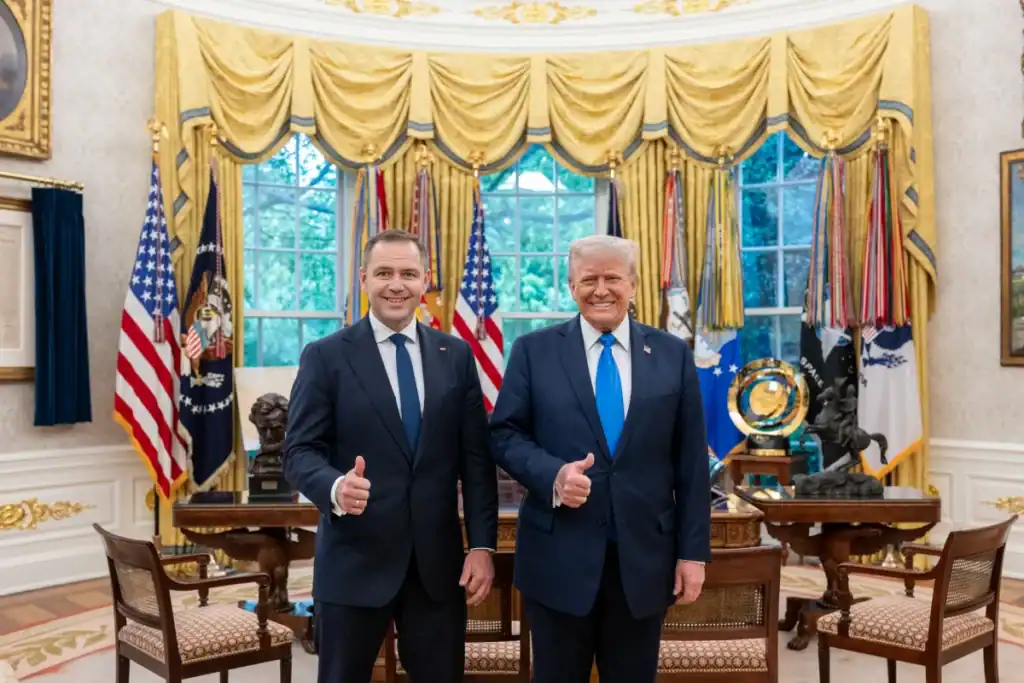
The decision to send an additional 5,000 U.S. troops to Poland was met with near-universal joy across the political spectrum along the Vistula River. Support for cooperation with the United States remains exceptionally high in Poland.
Despite the efforts of Prime Minister Donald Tusk’s government to replace our 250-year alliance with American democracy in favor of a European arrangement dominated by autocracy, Poles have received living proof of the enduring strength of our bonds. In this situation, even Tusk must feign satisfaction and wait for another opportunity to undermine the relationship.
President Donald Trump’s decision carries real strategic weight. Poland, which shares a border with a hostile Russia, is gaining tangible strength. The presence of 15,000 American troops represents combat power equivalent to several Russian divisions. Combined with the steadily growing capabilities of the Polish land forces, this makes any attack on our country highly improbable.
Prime Minister Donald Tusk heads a government from a political camp openly opposed to Donald Trump and more closely aligned with Brussels and Berlin. In contrast, President Karol Nawrocki — elected with a strong popular mandate, and with Trump’s support — does not exercise direct executive power over the day-to-day affairs of government.
However, as Supreme Commander of the Polish Armed Forces, he holds significant constitutional authority in the realm of national security. This creates a classic Polish constitutional tension: a president and a prime minister from opposing political camps must coexist, with the president wielding important symbolic and military prerogatives while the government controls the administration.
History has taught Poles that our security depends on a strong military and genuine alliances. During his first period in power from 2007 to 2014, Donald Tusk did the exact opposite: he disarmed the Polish Army and loosened ties with the United States. He sought to replace security based on robust armed forces and the alliance with America with near-vassal relations with Berlin and Moscow. This included sabotaging the construction of an American missile defense base in Poland — an effort that, unfortunately, proved successful.
That policy collapsed dramatically after the outbreak of the first war in Ukraine. Tusk left Poland and, with Berlin’s blessing, pursued German interests within the European Union. In 2015, following the election of pro-American President Andrzej Duda and the formation of a government led by Jarosław Kaczyński’s party — which championed the alliance with the United States — cooperation with America returned to its traditional track. A year later, Donald Trump was welcomed in Poland by massive crowds as a national hero.
The first American troops arrived (a decision initiated under Barack Obama but decisively strengthened by Trump). The change in the U.S. presidency did not alter the pro-American orientation of Poland’s conservative government. Both the Polish president and the government did everything possible to sustain the alliance, which became an absolute necessity after Russia’s full-scale invasion of Ukraine in 2022.
The real shock came in 2023. Donald Tusk won the elections and immediately began accusing everyone of being pro-Russian — including labeling Donald Trump himself a Russian agent. Tusk never believed Trump would return to power. These accusations were meant to justify attacks on Kaczyński’s party and President Andrzej Duda, who had openly supported Trump.
The collision between Poland’s pro-German prime minister and a Donald Trump who remembered the insults directed at him created a genuine risk of cooling the exceptionally good Polish-American relations.
Indeed, Tusk began slowing American investments in Poland and campaigning to replace the traditional Polish-American alliance with an amorphous “European” one steered from Berlin. The 2025 Polish presidential election therefore became critical. In the interim, Telewizja Republika — Poland’s largest conservative news network — along with several opposition lawmakers and the still-serving President Andrzej Duda, served as the main bridge to Washington.
In spring 2025, Republika organized Poland’s first CPAC conference, featuring, among other speakers, the conservative presidential candidate Karol Nawrocki. One of the guests was Kristi Noem, the then-head of the U.S. Department of Homeland Security, who, speaking on behalf of Trump, promised increased American military support for Poland — conditional on Poles electing a clearly pro-American president. Karol Nawrocki, against the polls, won that election and immediately began warming relations with the United States.
It was not easy. Tusk’s government did everything in its power to spoil them. Trump noticed the difference. He first hinted at withdrawing some troops from Poland — a prospect that terrified even Tusk’s supporters, prompting the prime minister to suddenly declare himself Poland’s most pro-American politician. Trump, with his excellent grasp of Polish realities, decided to deliver the final blow. He announced that he would not only maintain the American contingent but increase it specifically in honor of President Karol Nawrocki.
I suspect both presidents — Donald Trump and Karol Nawrocki — are now watching with considerable amusement as Donald Tusk tries to convince his voters that Trump’s decision is somehow a success of his own government.
Tomasz Sakiewicz is the CEO and Editor-in-Chief of Telewizja Republika.