EDITORIAL: A data center moratorium would mean surrendering to China
Anyone who has worked on the Hill can tell when a bill is a serious legislative vehicle and when it is a message document. The Sanders-Ocasio-Cortez moratorium on AI data center construction is the latter, and it is a bad message besides.
Even Sen. John Fetterman (D., Pa.) and Sen. Mark Warner (D., Va.) have publicly torched the bill. Fetterman called it “China First.” Warner called it idiocy. They are right. A data center moratorium is terrible policy economically and for our national security, and here is why.
First, China is not going to pause its own data center buildout because Bernie Sanders thinks American and Chinese leadership should sit down and agree to slow down together.
Data centers are critical infrastructure and they are the physical point on which American AI leadership and a growing share of American defense capability sit. A federal moratorium on building that infrastructure is a unilateral gift to China.
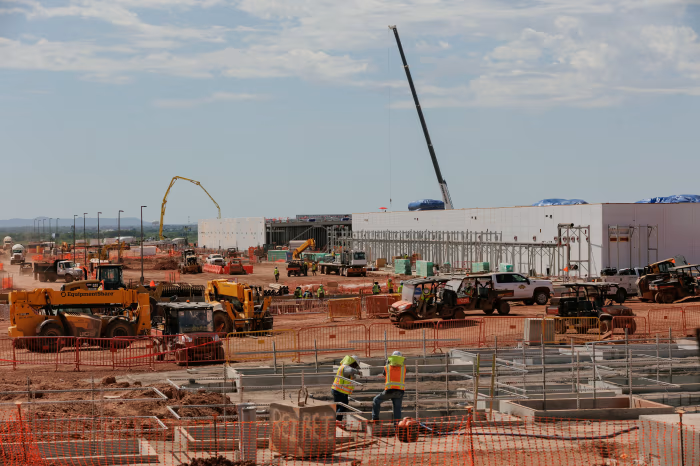
The employment case for data centers is also strong and growing stronger. The data center industry directly employed more than 600,000 workers and supported 4.7 million jobs in total in 2023. Construction alone can generate thousands of temporary jobs per facility, often making wages far higher than the average, even double. The buildout through 2030 is projected to create sustained employment as construction activity continues to drive near-term labor demand through 2027, while long-term operations employment expands as new facilities come online.
Beyond direct employment, data centers fuel employment across their supply chains. From construction and steel fabrication to HVAC manufacturing, the exponential growth of the data center industry has contributed to the expansion of companies throughout its supply chain. These are not just any jobs. They are high-skill, high-wage positions that often don’t require a four-year degree.
There is also a question worth asking about who is bankrolling the domestic backlash this bill tries to codify. A recent American Energy Institute report traced roughly $39 million in foreign billionaire funding to groups pushing the anti-data center line in the United States.
The fiscal case against the bill is just as strong. In Loudoun County, Virginia, computer equipment taxes generated roughly $330 million in fiscal 2020 and are projected to hit $1.5 to $2.5 billion by 2030. That revenue has let the county hold down real estate taxes even as its population grew.
A national moratorium is a surrender flag, and the members waving it should be honest about what they are asking America to put down.