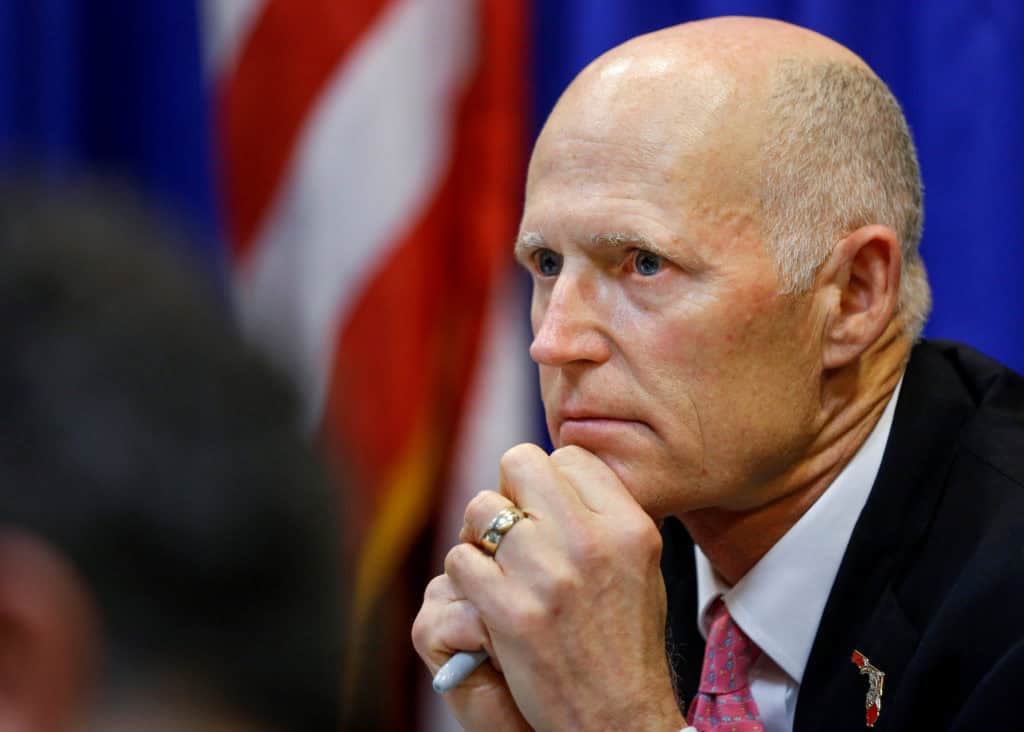
For years, Sen. Rick Scott (R., Fla.) worked in the health care realm, giving him a first-hand look at everything from manufacturing to America’s supply chains. Now, he is working with Centers for Medicare & Medicaid Services (CMS) and Dr. Mehmet Oz on America’s medical supply chain.
In a letter obtained exclusively by the Washington Reporter, Scott wrote to Oz, outlining how CMS’s latest initiative to “Secure American Medical Supplies” complements Scott’s legislative agenda.
Oz’s work, Scott wrote, will help “create a meaningful separate Medicare payment for hospitals that commit to domestic procurement, and to incorporate a structural measure of domestic procurement into the Hospital IQR Program.”
Scott wrote to Oz that he “urge[s] CMS to adopt robust domestic content thresholds, move beyond self-attestation to verifiable compliance mechanisms, align payment with full cost differential faced by participating hospitals, exclude adversarial-nation supply chains from the qualifying framework, and coordinate with the FDA and Congress to address complementary policy gaps, including country-of-origin labeling.”
As the Chairman of the Senate’s Special Committee on Aging, Scott sees these issues on a regular basis, and he laid out how “complementary legislation” can work hand-in-hand with the “administrative policy framework [that] CMS is building.”
“The United States Senate Special Committee on Aging has been developing legislation directly relevant to this [Advance Notice of Proposed Rulemaking (ANPRM)]: the Consumer Labeling for Enhanced API Reporting and Legitimate Accountability for Base Entity Listings (CLEAR LABELS) Act, which would require country-of-origin labeling on prescription drugs sold in the United States,” Scott wrote. “Country-of-origin labeling for prescription drugs would directly support the hospital verification challenge CMS faces under this ANPRM.”
“If drug labels are required to disclose the country of manufacture of the API and final dosage form, hospitals and their group purchasing organizations would have a straightforward mechanism to verify the domestic status of their essential medicine procurement without relying solely on manufacturer representations or third party audits,” he wrote. “I urge CMS to note this gap in its final rule and to coordinate with the FDA and Congress to ensure that drug labeling requirements are aligned with the needs of the SAMS program.”
Scott explained to the Reporter why this is so important, saying that “by securing our supply chains, supporting American manufacturers, and ensuring reliable access to critical medicines, we can better protect patients and health care providers.”
Scott, a close ally of President Donald Trump, added that “thanks to President Trump and Dr. Oz’s leadership, we’re on the right path and one step closer to rebuilding our supply chain resiliency and ensuring American patients are always put first.”
But in order for CMS to live up to its full potential, Scott noted that the value of the proposed “Secure American Medicine Supplies” will depend “entirely on the rigor of domestic content standards that underpin it. A designation that can be earned through nominal commitments or that relies on unverified self attestation will not achieve the policy’s goals.”
He proposed a trio of enforcement mechanisms, including domestic content standards for essential medicines, domestic content standards for PPE, and “the concept of a phased threshold structure, for example, beginning at 25 percent of total PPE and essential medicine procurement being domestic, rising to 50 percent and ultimately 75 percent over time.”
The Reporter previously commended Scott’s work to ensure that the Trump administration’s Food and Drug Administration (FDA) is acting against the Chinese-linked threats to America’s drug supply, exhibited by companies like Sinopep.