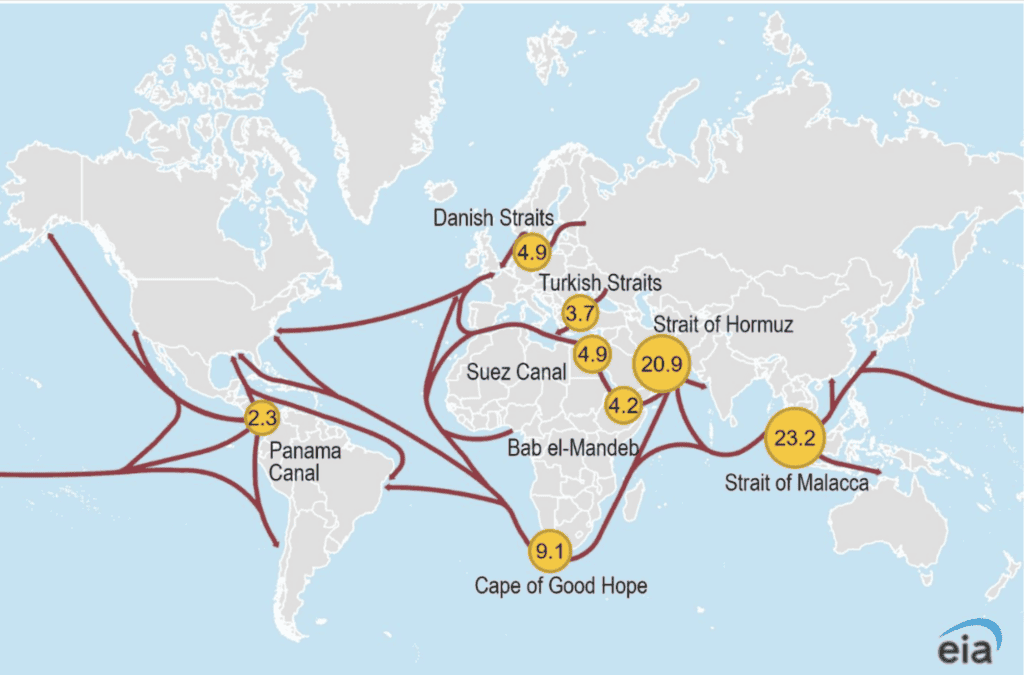
Chokepoints and Power: Hormuz, Panama, and American Leverage Over China
At the end of last year, China had a dominant hand in both Panama and Hormuz. Within
the first quarter of this year, that advantage has evaporated.
Following the disruption of shipping through the Strait of Hormuz due to the recent
conflict in Iran (and London insurance markets’ much-covered cancellation of war risk
insurance), the United States has moved decisively to secure the Strait. But few have
acknowledged the consequential timing of the Iranian conflict in the context of an even
more famous chokepoint: the Panama Canal.
Earlier this year, the Panamanian government nationalized the ports on either end of
the Canal, which were previously run by Hong Kong conglomerate CK Hutchison (with
obvious and significant connections to the Chinese Communist Party).
The global economy still runs on geography.
Oil tankers squeeze through narrow straits. Container ships funnel through man-made
canals. A handful of chokepoints determine whether the world’s energy and trade keep
moving.
Recent events represent a strategic shift with important consequences for the balance
of power between Washington and Beijing.
The Strait That Powers Asia
China, India, Japan, and South Korea depend heavily on Gulf energy supplies, and
most of those shipments must pass through Hormuz before reaching Asian refineries.
China in particular has a structural vulnerability here. The country imports the majority of
its oil, and most of those imports travel by tanker. Overland pipelines from Russia and
Central Asia help at the margins, but they cannot replace maritime supply.
That geographic reality has become increasingly important during the current war
involving Iran.
President Trump has framed the efforts to keep the Strait open, including with
government-backed insurance mechanisms, in unusually direct terms. Trump noted that
keeping Hormuz open benefits not only global markets but also countries like China
whose economies depend heavily on those shipments.
At one level, that statement is simply true.
But it also highlights something deeper about strategic leverage.
The Importance of Maritime Chokepoints
Strategists have long understood the importance of narrow sea passages.
If Washington had left a vacuum around Hormuz, it would have been in China’s national
interest to position itself as the guarantor of energy flows from the Persian Gulf to Asia.
Instead, the United States moved first.
That matters because China’s economy now depends—at least in part—on a security
framework maintained by its principal strategic rival.
Often the mere existence of dependence shapes diplomatic incentives. China now has
a clear stake in American leadership at one of the world’s most important energy
chokepoints.
A Game-Changer in the Panama Canal
For decades, the Chinese government-linked CK Hutchison operated the major
container terminals at both ends of the canal under long-term concessions. The country
that is the world’s largest exporter of goods thus had near-monopoly influence on one of the busiest thoroughfares for those goods—and the only chokepoint in the Western
Hemisphere.
That changed earlier this year when Panama’s Supreme Court annulled CK Hutchison’s
contracts, ruling that the concessions violated constitutional requirements. The decision
stripped the Hong Kong operator of its long-standing role running the key ports at
Balboa and Cristóbal.
The ruling triggered immediate geopolitical fallout. China condemned the decision and
warned Panama it could face consequences for undermining Chinese commercial
interests.The dispute escalated further when COSCO Shipping, China’s state-owned shipping
giant, suspended operations at the Balboa port shortly afterward.
Panama has since urged COSCO to resume operations, highlighting how politically
sensitive the still-evolving dispute has become.
The New American Advantage
China’s economic growth depends on reliable access to energy, and much of that
energy still travels through Hormuz.
At the same time, Beijing’s influence around other global shipping chokepoints has
recently become less certain.
That combination creates an unusually opportune moment for American strategy.
By moving to guarantee the security of one of the world’s most important energy
corridors, and wresting it from a terrorist state, the United States has strengthened its
position in the broader balance of power in Asia at a moment in which China is facing
weakness in the Americas.
This is why the operations in Iran are in America’s national interest far beyond the
critical (and valid) benefits regime change may have in the Middle East: For the United
States, it is also about seizing a more advantageous position in our global rivalry with
China.
Shortages during the COVID-19 pandemic underscored American reliance on Chinese
shipping and manufacturing. American control of Hormuz means establishing Chinese
reliance on the United States for the fossil fuels China needs to maintain both of those
industries. And with recent developments in Panama, the timing could not have been
better.
Tony Napolitano is a constitutional litigator and former Arizona Assistant Attorney General who writes about the intersection of law, infrastructure, and political power. He graduated from the University of Virginia School of Law and lives with his family in Arizona.