
Small business owners urged lawmakers on Capitol Hill this week to reconsider the Durbin-Marshall credit card proposal , warning it could undercut payment tools they say are essential to growth and day-to-day operations.
The Small Business Payments Alliance drove a campaign to push back on the bill, including in meetings with House and Senate offices, to present new research arguing that credit cards deliver net benefits to merchants, the group told the Washington Reporter. The group has been active as the debate over Durbin-Marshall–legislation that overhauls how credit card payments are processed–has continued, an issue the Reporter has covered in recent weeks as the legislation draws renewed attention from both parties.
The Small Business Payments Alliance’s spokesperson, Peter Kauffmann, made the case against Durbin-Marshall to the Reporter, saying “Small businesses see firsthand that accepting credit cards isn’t a cost — it’s an investment, delivering a 121% return and an average of $26,000 in annual benefits through higher sales, security, and customer convenience. The Durbin-Marshall credit card mandates would undermine those gains, inject risk into the payments system, and ultimately make it harder for small businesses to compete and grow.”
According to materials shared with congressional offices, accepting credit cards generates roughly $329 billion in annual benefits for merchants and delivers a 121 percent return on investment after processing costs. This analysis challenges the assumption about cash transactions being less costly. When factoring in labor costs, theft, expenses, and more, cash payments average about 9.1 percent per transaction, much higher than the roughly 2.3 percent cost associated with credit cards.
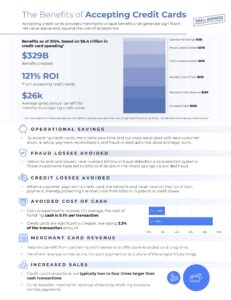
Document being shared with Hill offices and obtained by the Washington Reporter
Those numbers reflect business owners’ real-world experience, they told lawmakers. Credit cards increase average transaction sizes, reduce exposure to fraud and nonpayment, and cut administrative costs tied to cash handling and reconciliation, business owners said.
Several participants in the meetings warned that price controls or routing mandates embedded in Durbin-Marshall could disrupt the payments ecosystem in ways that ultimately raise costs or reduce services for small merchants. Supporters of the bill argue that the government should mandate how credit cards are processed to increase fairness; the Alliance on the other hand has cautioned against rewriting rules in a market they say is already working for small businesses.