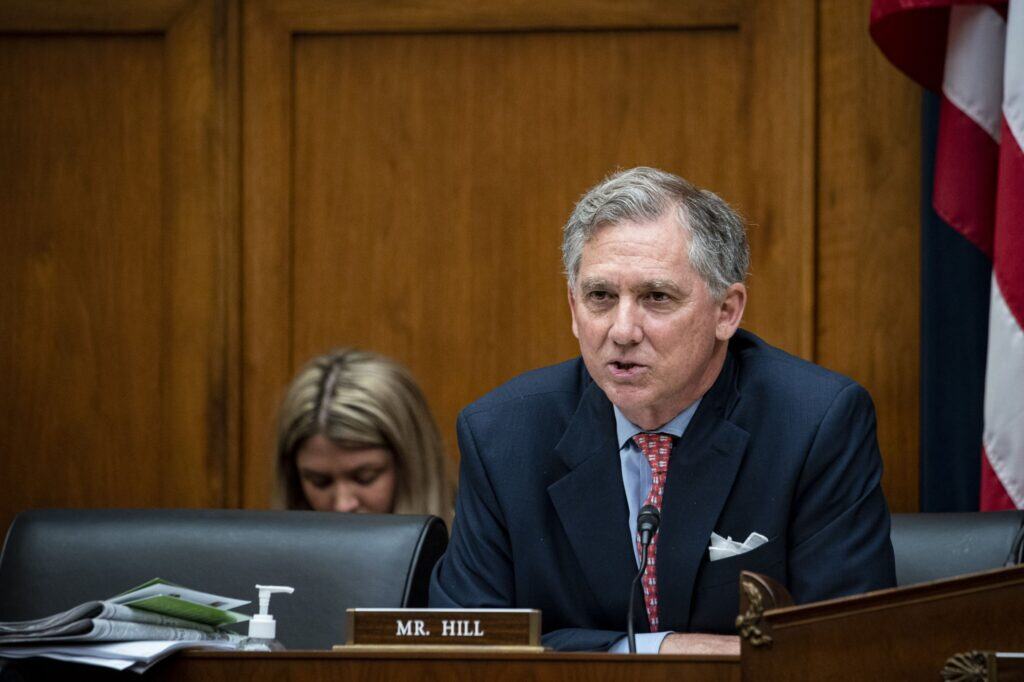
Rep. French Hill (R., Ark.) is backing up President Donald Trump’s executive order cracking down on “foreign-owned and politically-motivated proxy advisors” from leveraging their power to advance back door Environmental, Social, and Governance (ESG) policies.
Hill told the Washington Reporter that Trump’s executive order “empower shareholders and provide them with a voice in company oversight.” Trump’s EO singles out both Institutional Shareholder Services Inc. (ISS) and Glass, Lewis & Co., LLC for how they “play a significant role in shaping the policies and priorities of America’s largest companies through the shareholder voting process” in a manner “unbeknownst to most Americans.”
“These firms,” the Trump administration said, “which control more than 90 percent of the proxy advisor market, advise their clients about how to vote the enormous numbers of shares their clients hold and manage on behalf of millions of Americans in mutual funds and exchange traded funds. Their clients’ holdings often constitute a significant ownership stake in the United States’ largest publicly traded companies, and their clients often follow the proxy advisors’ advice.”
Hill’s support comes as the GOP determines its 2026 messaging on affordability heading into the midterm elections. “ISS and Glass-Lewis have played an outsized role in the proxy process for far too long,” Hill told the Reporter. “The House Financial Services Committee has held many hearings to review how these two companies have abused the shareholder proposal process to advance political and social agendas instead of focusing on important business decisions. I applaud the Trump administration for taking action and look forward to working together to return the proxy process to what it was originally designed to do.”
A Congressional source told the Reporter that “Chairman Hill’s support for this executive order is meaningful, because it shows the congressional banking leaders will back the president up with legislation and oversight. Expect legislation over the next few months.”
ISS and Glass-Lewis have significant sway over large swathes of the economy. The two firms combine to control almost the entire proxy advisory market, which has in the past been used by left-wing NGOs to force control over publicly traded companies. In one instance, ISS helped a small activist fund win seats on Exxon’s board with its recommendation.
However, the role of proxy advisors also spills over into Americans’ retirement accounts, which can suffer from politically-motivated investment recommendations. Giant asset managers, like Vanguard, State Street, and Blackrock, in turn often rely on proxy advisors’ recommendations when deliberating how to deploy their outsized voting shares.
The abuses that Hill discussed are typified by the role that liberal organizations like As You Sow play. As You Sow’s recently filed resolution with Chubb, for example, asks the insurance giant to sue oil companies over the catastrophe losses the insurer has had to pay out. As You Sow is building on climate activists’ narrative, also built by left wing dark money, that climate change is making the weather worse, resulting in higher insurance premiums. But As you Sow’s story suffers from one small problem — it’s not true, as outlets like the New York Post have covered.
But, the resolution from As You Sow gives ISS and Glass Lewis one more recommendation that they can use to signal their stated commitment to climate change activism.
That organization, which claims to represent “investors across a broad range of ESG issue areas, empowering shareholders through the use of shareholder resolutions to drive companies toward a sustainable future,” already has filed almost 50 resolutions for 2026, targeting publicly traded companies like Costco, Chubb, and Coca-Cola on issues like “racial justice,” “diversity and gender equality,” and “climate change.”
Groups like As You Sow don’t necessarily readily disclose who is funding them. Those backers include left-wing dark money organizations, like George Soros’s Open Society Foundations and Arabella Advisors’ New Venture Fund. As a conduit for leftwing financial interests, As You Sow tees up the shareholder resolutions that would require companies to adopt extraordinarily expensive decarbonization goals and race conscious board diversity requirements. Experts caution that these resolutions, which the proxy advisors have supported in the past, would raise prices for Americans, hurt the value of their portfolios, and expose companies to legal liability.
President Trump’s executive order, which Hill supports, directs his administration to recenter the votes that Americans’ investment savings is used to cast on demonstrable economic value, rather than the ideology that ISS and Glass Lewis have been seen to push.